
How do we make sense of the religious iconography that we increasingly see as part of the CPI(M)’s visual identity in Kerala? Anagha looks at what it means for an atheist-secular political party to turn to religion for its imagery.
Anagha Anil
An iconic scene from the classic Malayalam political satire Sandesam (Anthikad, 1991) features Prabhakaran (played by Sreenivasan), a loyal partisan of the fictional Communist Party RDP (Revolutionary Democratic Party), calling out its leader Kumara Pillai’s (played by Shankaradi) hypocrisy. Prabhakaran mocks Pillai’s professed atheism, revealing that the leader secretly visits a temple every day with his head covered by a towel to avoid being recognised. When a startled Pillai enquires how he knows this, Prabhakaran wryly responds that he does the same thing. Though humorous, the scene portrays the intractable tension between ideology and socio-cultural reality, whereby Kerala’s communists often interact with religious beliefs despite their formal commitment to atheism.
The Communist Party’s engagement with religion has been a subject of controversy, with recent incidents such as the 2025 Sabarimala summit organised by the Left Democratic Front coalition (LDF) fueling debates on the Party’s ideological integrity (‘the Party’ throughout refers to CPI(M), the party leading the LDF coalition). The rising visibility of the BJP as a formidable political power in Kerala alongside the growing popularity of community-based politics in the rest of India are some of the reasons for the Left’s religio-political reconfiguration in Kerala. Such engagements are also expressed through the visual vocabulary of the Party, whereby posters, pictures, sculptures, graffiti, installations, and other artefacts have courted controversy for their appropriation of religious symbols and figures during the last twenty-five years (2000-2025). An infamous example would be the Janmashtami procession— an event conventionally hosted by Balagokulam (an organisation affiliated with the RSS)—organised by the Party in 2015. Titled Namukku Jaathiyilla (we have no caste), the procession featured children dressed up as Krishna, prompting criticism from various quarters, with many questioning the secular character of the CPI(M). The Party’s incorporation of religious figures was also on display during the state-level conference in Alappuzha for its display of Catholic saints Euphrasia and Kuriakose Elias Chavara (The News Minute 2015). The subsequent district-level conference of the Party held in the district in 2018 took it further by depicting Jesus Christ as a revolutionary who fought for the downtrodden. The increasing incidence of such representations suggests that the visual identity of communism in Kerala is changing significantly. These shifts are worth our attention because they constitute a kind of myth-making that shapes left populism1 in Kerala today.
Why is myth-making so important to the CPI(M)? Though we popularly associate myths with religion, they have a broader significance in human life, which cultural theorist Roland Barthes has explored in-depth in his book, Mythologies (1957). Barthes sees myth very broadly, as a form of speech which exists beyond direct/literal (‘denotative’) meaning. That is, myths are culturally constructed meanings or values that are attached to everyday objects, practices, and symbols, and are often fashioned to reinforce dominant ideology or to benefit those who occupy powerful positions in society. Thus, myths are not pre-existing truths, but ideas that are produced and rendered true over a period of time through repetition and rituals, which naturalises their existence. Hans Blumenberg (1979) looks more closely at this process of repetition and ritual that keeps myths circulating. He uses the concept of ‘work on myth’ (arbeit am mythos in German) to draw our attention to how the basic narrative of a myth is reworked over time because each occasion calls for different needs and exigencies. This process of reworking myths is not carried out by a single person or entity, but comprises multiple participants who could also function as re-narrators. Through the work of repeating and reworking myths that are already deeply rooted in the everyday worlds of the people, we can see how the CPI(M) becomes an ‘affective’ presence in Kerala, appealing not just to rationality but also to the emotional sphere of people’s lives.
This strategy was very evident at the 23rd Party Congress held in Kannur in April 2022, where pictures, graffiti, street art, and installations included ritualistic art forms and folk deities such as Theyyam and Parasinnikadavu Muthappan.
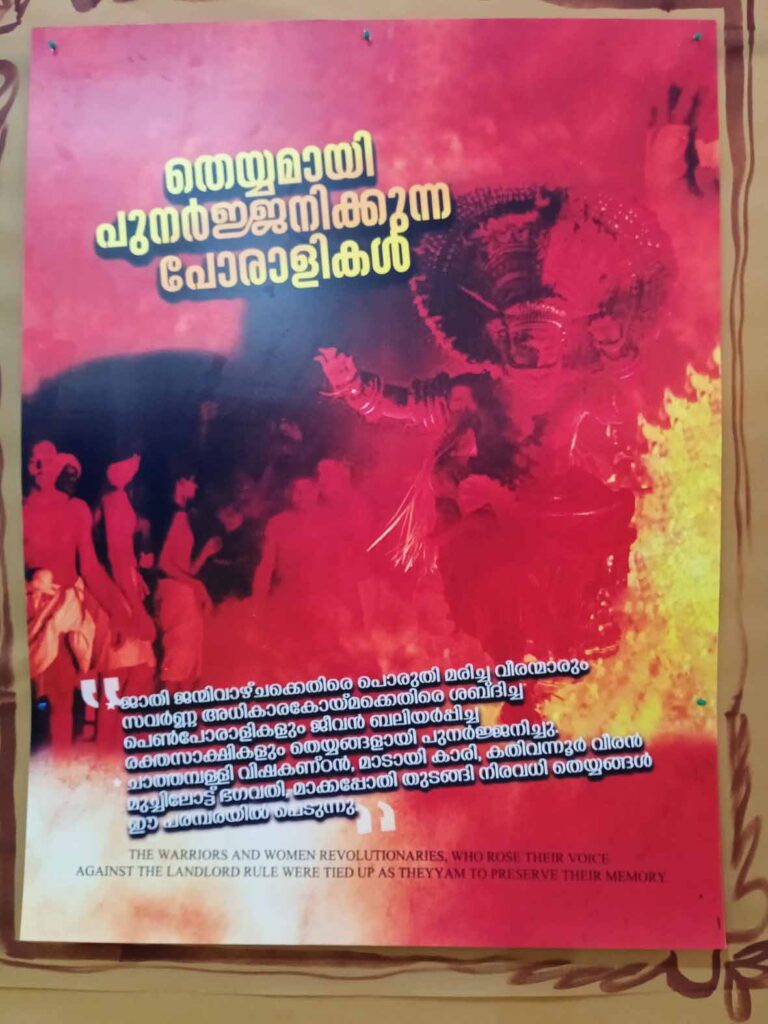
The visual appeal of the fiery red apparel used in Theyyam and the associated mythology is made to blend with communist discourse and iconography. In this vein, an exhibit at the history exhibition organised as part of the Party Congress describes the Theyyamkalakaran (the person who embodies the spirit of the subaltern God) as the reincarnation of the tiller, whose death was a consequence of the brutalities inflicted by the feudal lords. The vengeful subaltern God, narrates the exhibit, takes the form of the ferocious warrior. Clad in vibrant costumes, the ritual dancers depict the brutal oppression the subaltern castes (especially the Malayar and Panikkar) encountered at the hands of the feudal lords.
Eby, the Vice Chairman of the History Exhibition, explained, ‘Theyyam is a symbol of subaltern resistance, a reaction against the oppression and torture faced at the hands of janmis (feudal lords). Theyyam provided them an opportunity to transcend these hierarchies’. Another informant, Pramod, also added that Theyyam was included because of the significant position the art form occupies within the socio-cultural terrain of Kannur. I then asked Pramod whether there was an incongruity in featuring a religious art like Theyyam in a Communist arena. To this, he replied, ‘The religious aspect of the art form is of no interest to the Party. The performer becomes interchangeable with the divine only when he engages in ritualistic actions such as bestowing blessings or applying vermillion on the devotees’ foreheads’. Such interpretations recast Theyyam as an expression of subaltern history, resistance, and political will while de-prioritising the religious elements of the form. Attributing such new meanings to a folk art otherwise solidly embedded within the ritualistic milieu transforms Theyyam into a political artefact that embodies communism, much like the posters, pictures, graffiti, and hoardings bearing images of former leaders like Lenin, Stalin and Che Guevara encountered on the streets of Kerala.2
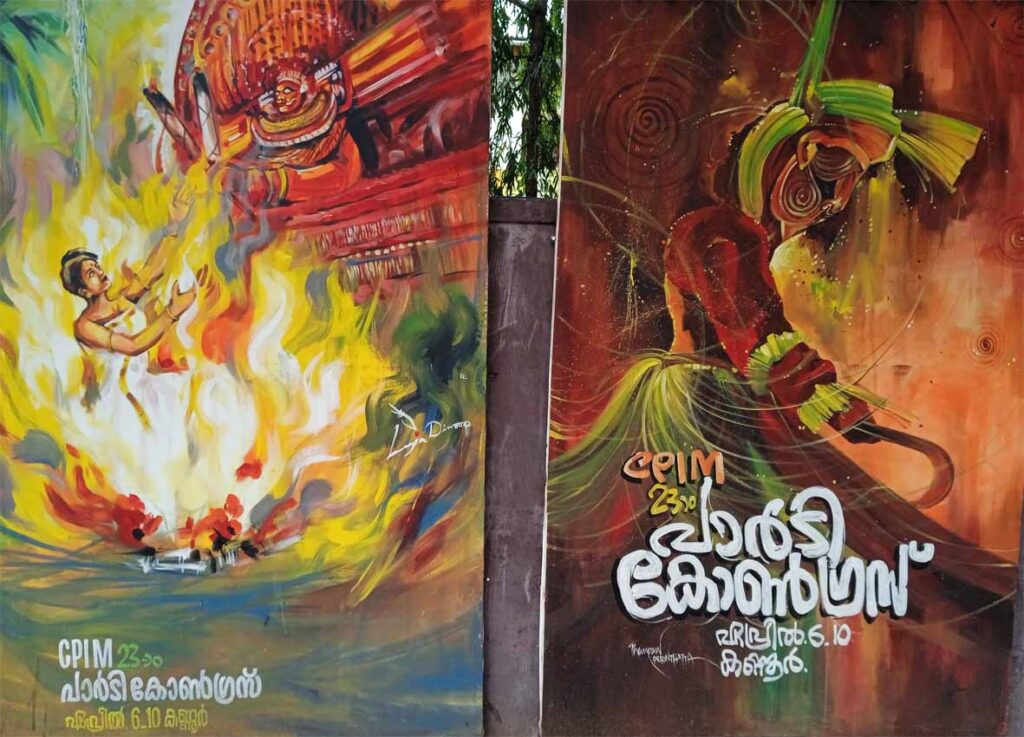
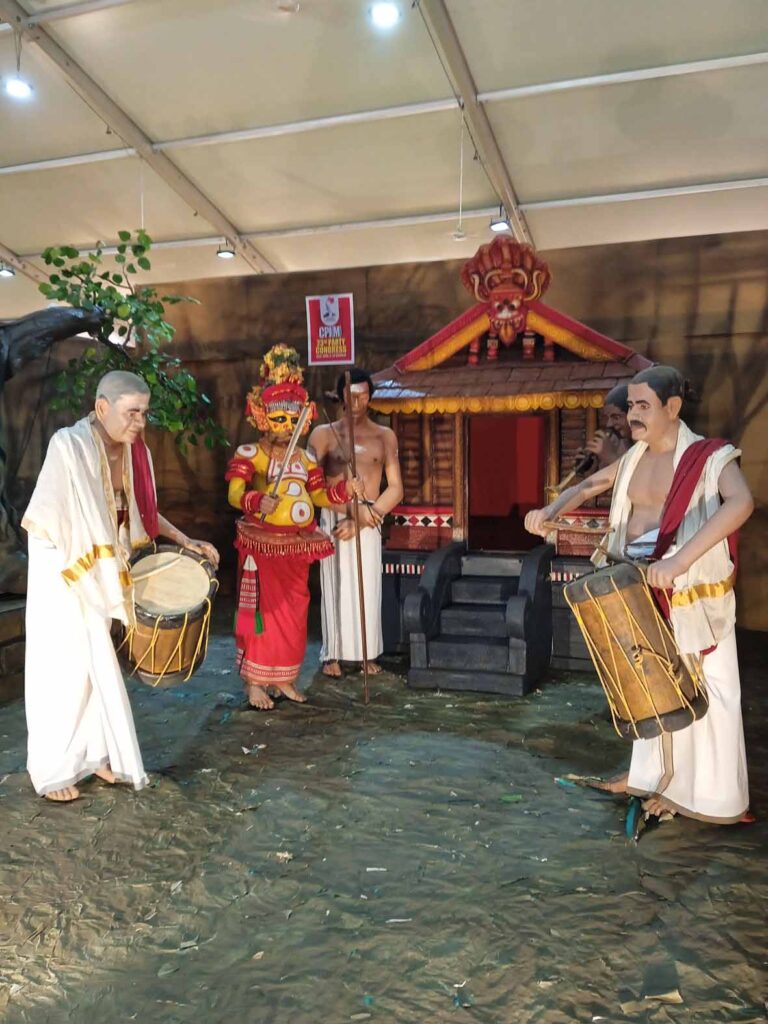
Parassinikadavu Muthappan, a local deity, was similarly utilised for elevating the affective capacity of communist visuals during the Party Congress. An installation at the History Exhibition showcased a Muthappan Theyyam performance outside a temple-like structure; the very presence of which at the venue of the Party Congress is surprising considering the atheistic and rationalist principles the Party upholds. There were also several wall paintings of Muthappan in and around the city, accompanying announcements of the Party Congress. Nitasha Kaul and Nissar Kannangara (2023) discuss this seemingly unlikely connection of the regional deity with communism in their ethnographic study of Kannur. As a rebellious God who loves meat, dried fish, and toddy, the Muthappan deviates from the norms and customs associated with the rest of the Aryan Gods. These tendencies, which confer a defiant aura, are also why Muthappan Theyyam is affectionately referred to in some places in North Kerala as communist Theyyam, they observe. They also note that the prominent shrine of Muthappan in north Kerala, the Parassinikadavu Muthappan Temple, has long been managed by CPI(M)-backed trustees. The Party’s use of the deity’s images invokes this association and the affective presence of both the Muthappan and the Party in the lives of Kannur’s people. Attributing an organic nature to the Communist movement in Kerala, these regional/religious markers embed the Party within the culture, memory, and folk traditions of the region.
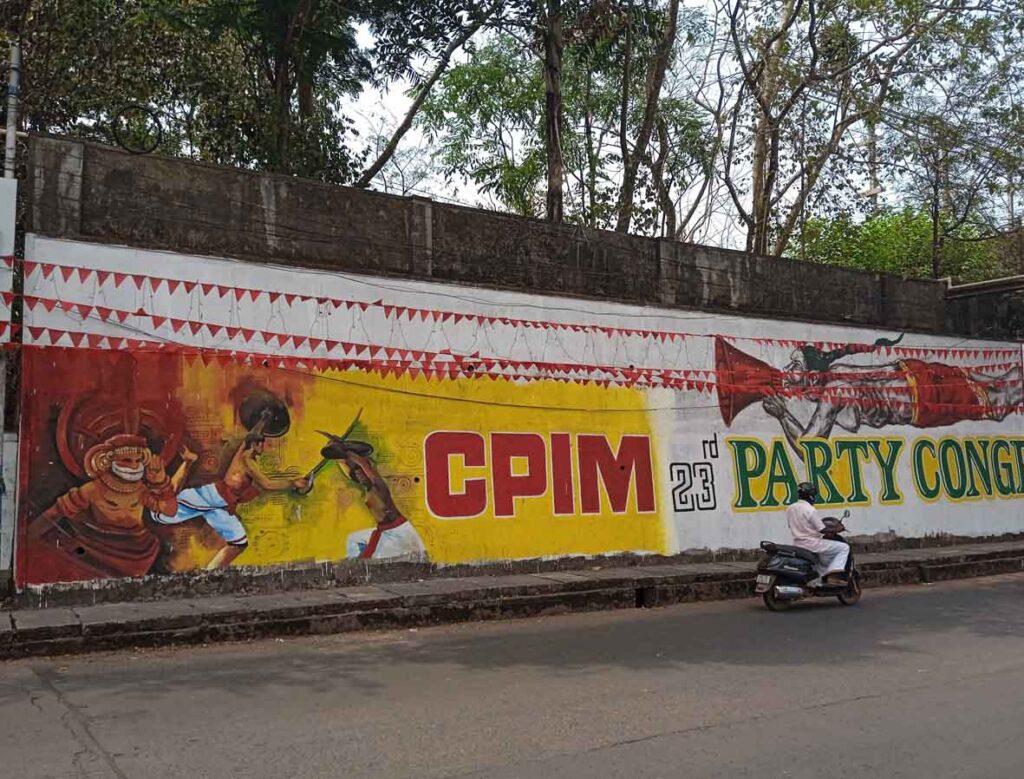
Whereas it is evident from the local epithet of ‘communist Theyyam’ that Communism has a long-standing relationship with local religious symbols, what we see in spaces like the 23rd Congress is a new phase in this relationship.3 In a scenario where right-wing forces are increasingly providing representation to minor Hindu traditions to shape their own populist ideologies, the Party faces added pressure in vying for the loyalty of marginalised local communities. When read alongside such recent developments, these new narratives and myths produced and accommodated by the Party could be understood as part of a dynamic visual vocabulary that is consistently amended to suit the electoral and cultural requirements of the time. Like speeches and opinion pieces, the iconographic repertoire of the Party also functions as a medium that communicates the ideological shifts of the organisation to the people. Thus, myth-making here is not a passive process but an act of conscious representation which ensures the persistence and affective presence of the Party in Kerala.
Works Cited
- The News Minute, 2015. ‘Catholic church in Kerala says they have good reason to be upset with CPI M‘. The News Minute, February 17, 2015. Accessed: June 11, 2022. https://www.thenewsminute.com/kerala/catholic-church-kerala-says-they-have-good-reason-be-upset-cpi-m-17074.
- Asianet News. 2018. ‘CPIM sammelana vediyil Christuvinte chithravum‘. [Christ’s picture seen at CPI(M) meeting venue]. Asianet News. October 2, 2018. Accessed June 15, 2022.
- Agarwal, Samantha. 2023. ‘Dalit Defection to the BJP in Communist Party-Ruled Kerala: Caste and the Limits of Redistribution Without Recognition’, Unpublished PhD diss., Johns Hopkins University. https://jscholarship.library.jhu.edu/items/8b520d55-f35c-4d8d-841c-b9af2f7830f3
- Anthikad, Sathyan. 1991. Sandesam. Kerala: Evershine Release.
- Barthes, Roland. 1972. Mythologies, translated by Annette Lavers. New York: Noon Day Press.
- Blumenberg, Hans. 1990. Work on Myth, trans. Robert M. Wallace. Cambridge, MA: MIT Press.
- Kaul, Nitasha, Kannangara, Nissar. 2023. ‘The Persistence of Political Power: A Communist “Party Village” in Kerala and the Paradox of Egalitarian Hierarchies’. Int J Polit Cult Soc 36: 227–257. https://doi.org/10.1007/s10767-021-09411-w.
- Mannathukkaren, Nissim. 2013. ‘The Rise of the National-Popular and Its Limits: Communism and the Cultural in Kerala.’ Inter-Asia Cultural Studies 14, no. 4: 494–518.
- Menon, Dilip M. 1993. ‘The Moral Community of the Teyyattam: Popular Culture in Late Colonial Malabar’. Studies in History 9, no. 2: 187–217. https://doi.org/10.1177/025764309300900203.
About the author: Anagha Anil is an independent researcher. She received her PhD in Cultural Studies from Manipal Academy of Higher Education (MAHE), Karnataka. Her PhD research focused on the embodied aesthetics of communist iconography in contemporary Kerala (2000-2025). Her research interests include visual studies, popular culture, and film studies.


Interesting read.Truthfully analyses the use of the usually religious icons by the party for practical ends pressurised by socio-cultural and political realities.The atheistic ideology of the communist party with its foreign origins would definitely find it hard to survive in Bharath with its rich cultural ,philosophic,spiritual and religious traditions ,featuring a legion of gods and goddesses catering to the needs of the subaltern and the high priests.The infamous “adavu nayam” of the party is deployed here also.