
Jubin Abraham explores how the Kochi-Muziris Biennale reimagines Kochi’s colonial edifices as living archives of memory, where contemporary artistic interventions recover suppressed histories and open new possibilities for decolonial remembrance.
Jubin Easow Abraham
Historical edifices transcend mere physical relics, serving as a shared realm of consciousness that embeds interwoven legacies into tangible spaces and perpetuates a collective memory of the past. Drawn from bygone values, symbols, and experiences, these collective recollections emerge as a contested site for reflecting the historical continuity and identity of the society. Moreover, these structures not only preserve the past but also materialise society’s agency in remembering, sustaining, and disseminating it. From the fourteenth century, after the fall of Port Muziris, a bustling trade centre rose to prominence on the Malabar coast, and travellers and merchants variously rendered the region Kochchi, Cocym, Cochym, Kochi, and Cochin. Extending from present-day Fort Cochin to Ernakulam, the area, from its origins as an ancient port city to its current role as Kerala’s economic capital, remains a timeless emporium of history that harbours vessels of layered memories. With storied Chinese fishing nets, the ancient Jewish synagogue, colonial architecture, contemporary commercial high-rises, and wall posters, the place weaves a vivid tapestry of antiquity’s commerce and migrations, the enduring imprints of colonial rule, and everyday lives that arrived, thrived, and vanished within its bounds.
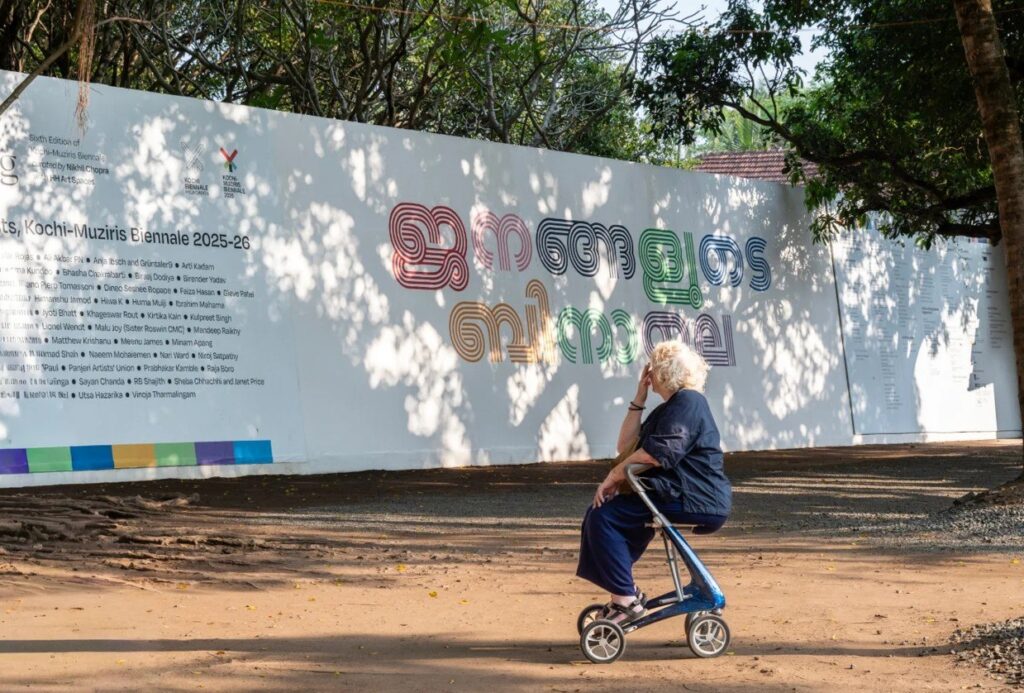
‘With the possibilities of erasing boundaries’ (Krishnamachari and Komu 2012: 28), the Kochi-Muziris Biennale inaugurated India’s pioneering contemporary art biennial in 2012, embodying Kochi’s boundless confluence of heterogeneous cultures through seamless blends of local legacies and global historical, artistic, and cultural dialogues. Bose Krishnamachari, co-founder of the Kochi-Muziris Biennale, says Kochi was the obvious choice of venue when India’s first biennale was proposed. He notes, “Location plays an important role when you create a festival like a biennale, and Fort Kochi and Mattancherry is an ideal location not only for creative projects, but even sociologically, its multiculturalism gives us so much confidence” (V.N. 2022). Across the six Kochi-Muziris Biennale editions, the latest of which concluded on March 31, Kochi has served as a vital haven of belonging for diverse voices from around the globe.
As the viewer moves through venues ranging from Fort Kochi and Mattancherry to Willingdon Island and downtown Kochi, where every breath bears the imprint of the past, they transform into an active participant. They encounter sight, sound, touch, and scent that enfold them in the consciousness of those who came before and linger within them. While immersed in the sensory domain of yore, the Biennale carves out novel discursive spaces wherein participants encounter the decolonisation of collective memory tied to imperial epochs. However, since its inception, public recognition of viewing arts as a necessity has remained marginal, a reality reflected in state funding patterns (Abraham 2024: 66). Although the Kerala government has pledged support for an international cultural event since 2012, organisers have routinely faced long delays in receiving the promised allocations. To mitigate these funding shortfalls, the biennale has created a category of year-round donors, termed ‘benefactors,’ whose sustained contributions help fill the gaps left by delayed public allocations (Jhala 2025).
Decolonial Whispers from Colonial Walls
As Joseph Koerner articulated, ‘Monuments are built obstinately to endure’ (Koerner 2016: 6). The colonial buildings of Kochi, akin to monuments across the postcolonial world, furnish a direct lens into their imperial functionalities, how they operated, were maintained, and were negotiated within the region’s sociocultural and political fabric. On 26 February 1901, addressing the Asiatic Society of Bengal, Viceroy Lord Curzon proposed an innovative historical record: a public display of objects to supplant secluded texts in libraries and archives. For Curzon, it provided the British, ‘a standing record of our wonderful history, a visible monument of Indian glories, and an illustration, more eloquent than any spoken address or printed page, of the lessons of public patriotism and civic duty’ (Speeches by Lord Curzon of Kedleston, Viceroy and Governor General of India, Vol II 1900-1902, 1902: 214). However, for its roughly 110-day run from December to March, the Biennale staged its exhibitions across these structures, from Portuguese and Dutch edifices, spice godowns, and warehouses to British offices and bungalows, not as records of imperial legacies, but as dynamic sites for reclaiming the past from the standpoint of the forgotten. The walls began to whisper for the faceless, the excluded, and the repressed, those eclipsed by colonial ambition.
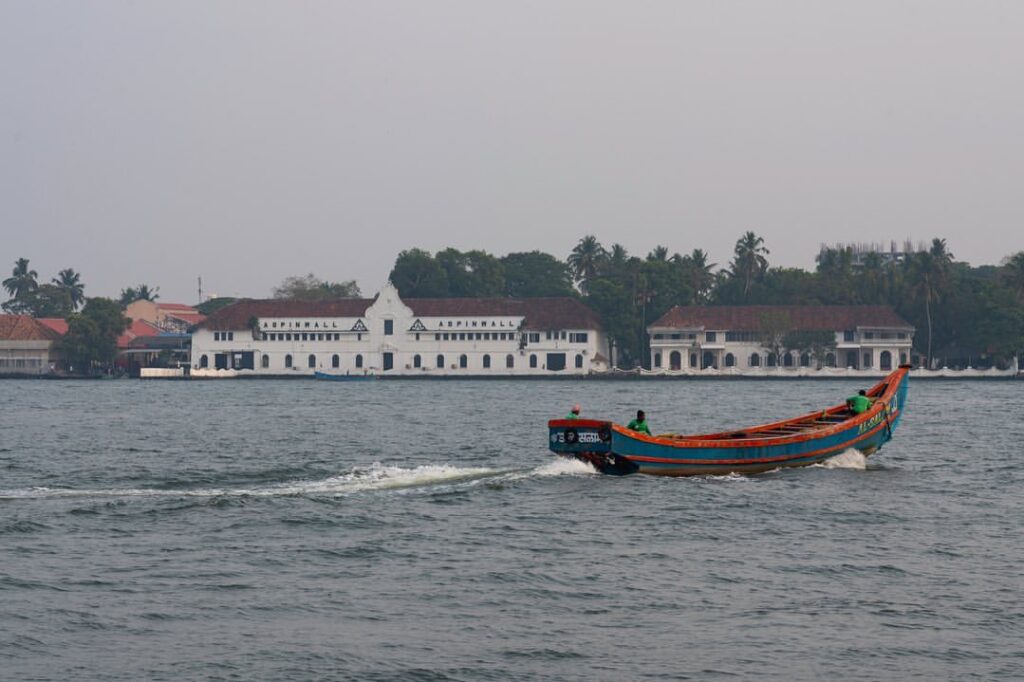
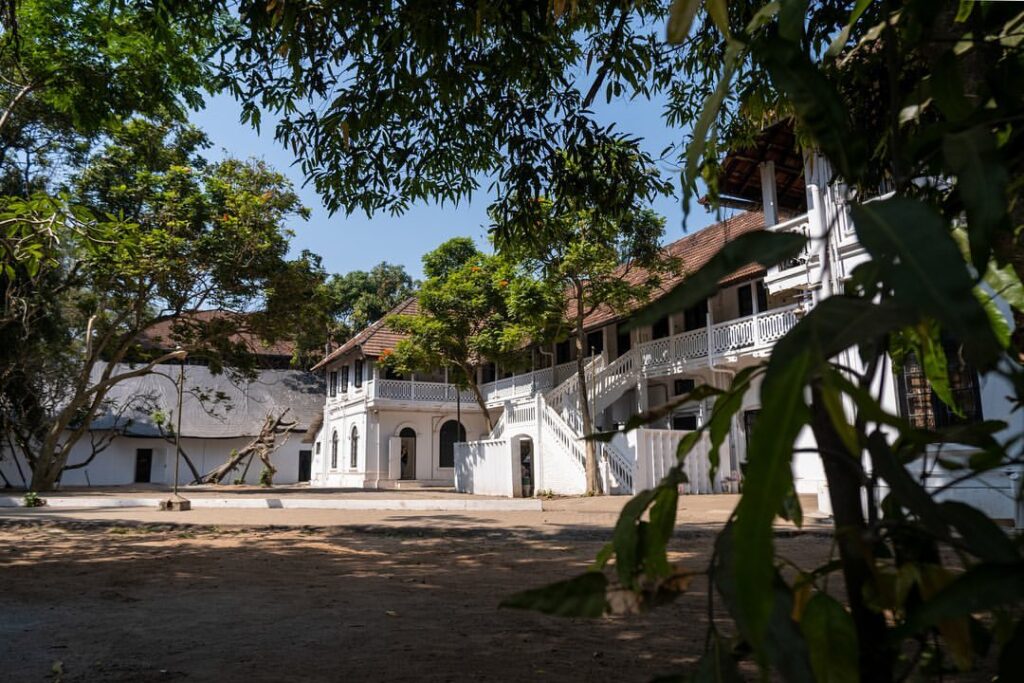
From afar, Fort Kochi’s shores reveal the Biennale’s central venue, Aspinwall Hall, with its legacy spanning over 180 years (Krishna 2022). Established under the East India Company and later by John H. Aspinwall of Aspinwall & Co., the building emerged as one of the region’s pivotal hubs for overseeing trade during the colonial occupation. In Aspinwall Bungalow, Shiraz Bayjoo’s Sa Sime Lamer transcends the room’s memories of official imperial trade narratives, evoking echoes of forced production under extractive dominion. Nearby, Huma Mulji’s Bombay Duck, facing the Arabian Sea, was where colonial officials once gazed upon the waters as boundless opportunities. Departing from ‘opportunities,’ the work delivers potent rhetoric on exiled bodies fleeing from the port and their adaptive moorings wherever they land. Adjacent to the Bungalow, the Coir Godown, an old warehouse of finished goods primed for export, yet blind to the hands that made them, now hosts the Panjeri Artists’ Union’s A 100- Day Living Installation. The walls of the godown brim with tales of lives excluded by caste and class, including Kirtika Kain’s Tar, Gold, and Copper, unearthing the Dalit diaspora’s erased legacy from official history.
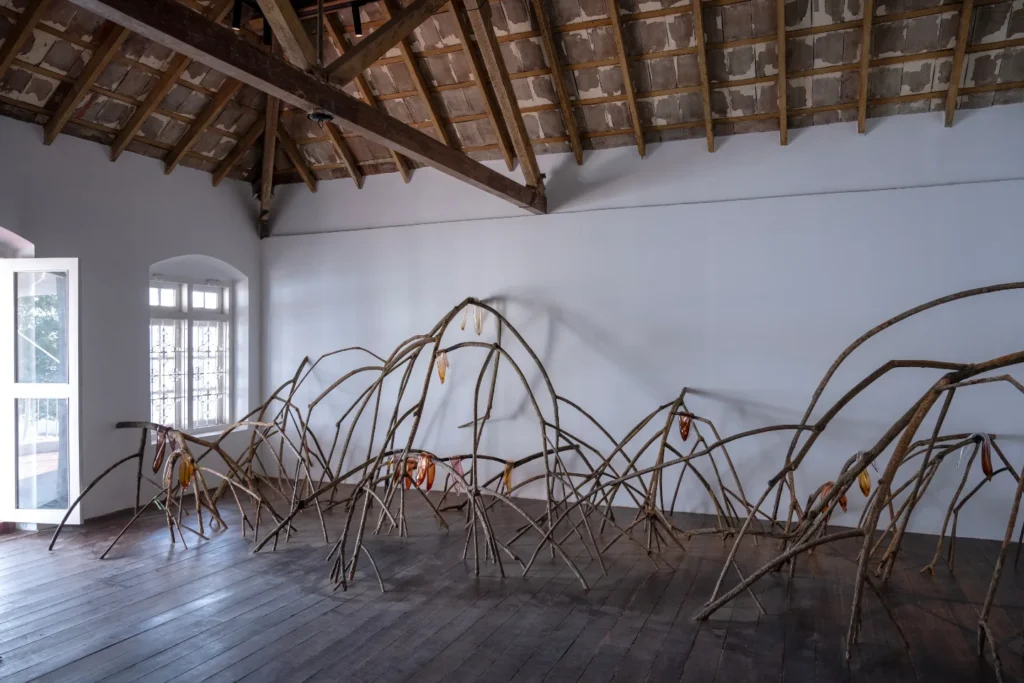
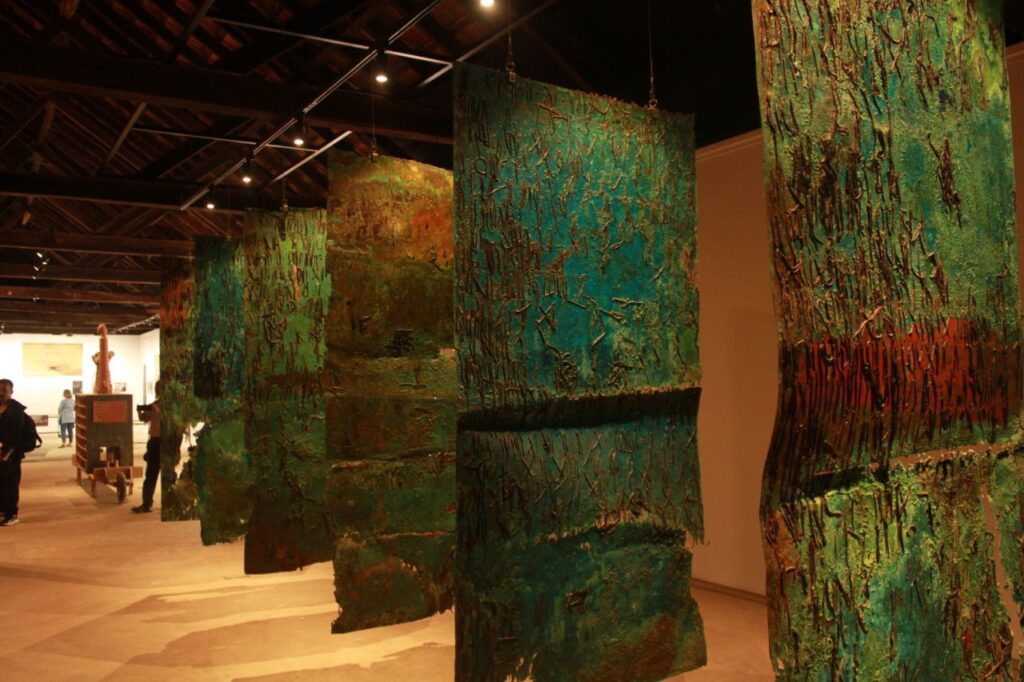
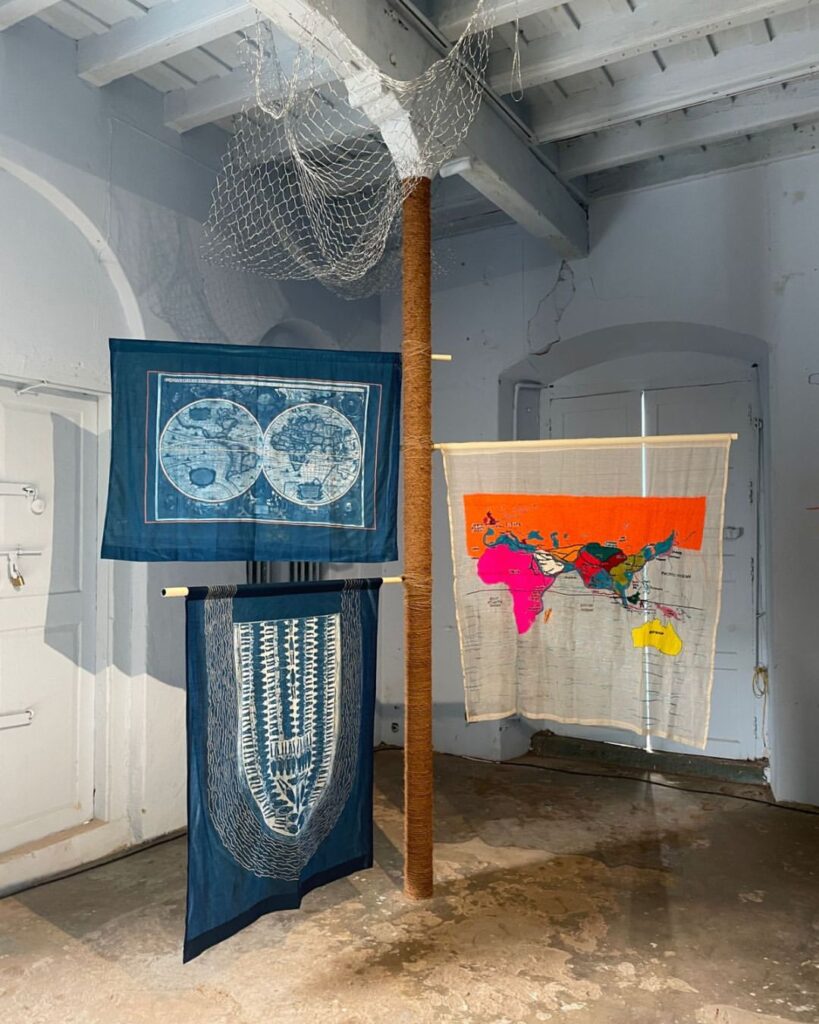
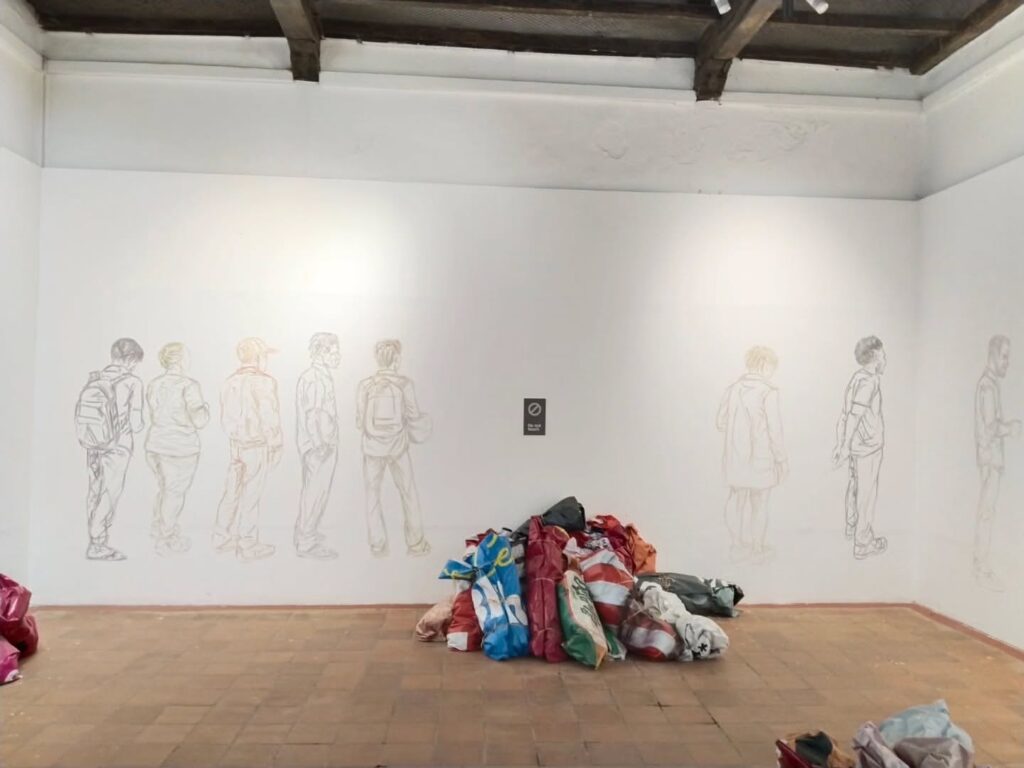
Alongside Aspinwall Hall, Pepper House, another historic spice godown with Dutch-style clay roofs and a vast courtyard, once used to store goods for ships in Kochi harbour, stands as a monument to the prosperity of global colonial trade. It hosts Jompet Kuswidananto’s Ghost Clothes That Play Music, which traces the persistence of colonial trauma through Fado, Keroncong, and other musical forms. Here, music serves as a mnemonic, defying the house’s willed amnesia. Similarly, Ibrahim Mahama’s Parliament of Ghosts inside Anand Warehouse, Yasmin Jahan Nupur’s Black Gold, Otobong Nkanga’s Soft Offerings to Scorched Lands and the Brokenhearted at 111 Markaz subvert the historical roles of these structures, forging spaces of contestation between recollection and oblivion. The bodies in Peterson Kamwathi’s Scree celebrate the enduring ties between Kochi and East Africa’s coast. Perfectly suited in the 1695 Dutch building, later named David Hall, the work resurrects memories of forgotten slave bodies from East Africa, where the Dutch dominated the slave trade from those regions, and hurls participants back to that brutal past.
Appropriating Bodies as Living Counter-colonial Archives
‘We see the body as a landscape of time, a vessel of labour, joy, and loss.’ According to the curatorial vision, ‘From these bodies emerge processes that transform into other bodies as extensions of ourselves through which meaning is carried, and reality reimagined’(“Sixth Edition: For the Time Being” 2025). In postcolonial contexts, the embodied experience is central to reconstructing historical narratives. By situating the participant’s body amid colonial edifices resounding with the voices of the silenced, the Biennale transforms the body into a site of resistance against hegemonic colonial historical accounts. Accordingly, revisiting, reconstructing, and reclaiming the fragments of the past within this symbolic space enables the appropriation, alteration, and subversion of knowledge and perception. As history remains an ‘unfinished’ endeavour, continually processed and internalised in quotidian social life, the Kochi-Muziris Biennale, unfolding across the colonial environs, intersects body, memory, place, and history. This convergence blurs the boundaries between past and present, belonging and exclusion, remembrance and forgetting, reanimating decolonial possibilities.
References
- Abraham, Tanya. 2024. “Rethinking Funding for the Arts in India.” On Curating.
- Jhala, Kabir. 2025. “Sixth Kochi Biennale: What’s on Show and Who Is Funding It.” The Art Newspaper, December 9. https://www.theartnewspaper.com/2025/12/09/kochi-biennale whats-on-show-and-who-is-funding. [Last Consulted on 23 June 2026]
- Koerner, Joseph Leo. 2016. “On Monuments.” Anthropology and Aesthetics, no. 67/68: 5–20.
- Krishna, P. S. 2022. “Aspinwall House: The House of Legacy.” The New Indian Express (Kochi), December 10.
- https://www.newindianexpress.com/cities/kochi/2022/Dec/10/aspinwall-house-the-house-of legacy-2526620.html. [Last Consulted on 16 April 2026]
- Krishnamachari, Bose, and Riyas Komu. 2012. “Salt Heals\ Curator’s Note.” In India’s First Biennale 12\12\12. Kochi Biennale Foundation.
- “Sixth Edition: For the Time Being.” 2025. E-Flux, July 15. https://www.e flux.com/announcements/6783901/for-the-time-being. [Last Consulted on 16 April 2026]
- Speeches by Lord Curzon of Kedleston, Viceroy and Governor General of India, Vol II 1900- 1902. 1902. Office of the Superintendent of the Government of India.
- V.N., Ashwin. 2022. “Why Fort Kochi and Mattancherry Became the Venue of the Kochi Muziris Biennale.” The Hindu, December 6.
- https://www.thehindu.com/entertainment/art/why-fort-kochi-and-mattancherry-became-the venue-of-the-kochi-muziris-biennale/article66164130.ece. [Last Consulted on 23 June 2026]
About the author: Jubin Easow Abraham holds an MPhil in History from the University of Kerala. His research interests explore the subjective dimensions of historical change in South Asia, with a particular focus on emotional history. He examines the complex interplay between emotions, sociocultural relations, and structures of power.


