
The ‘pooja room’ seems to be a universal fact of Hindu life in Kerala, but is in fact a very modern invention. Drawing on observations of his own milieu, Gautham examines the history and implications of how the ‘pooja room’ became a standard part of modern dominant-caste homes.
Gautham Krishna
‘Even I have a few conditions’, my friend’s mother said, as they mapped out the blueprints for their future home. As I watched, the casual conversation about the house they hoped to build soon quickly turned into a debate. My friend had her own vision: big windows, an open kitchen, and a minimalist aesthetic. Her mother, however, had different priorities. First and foremost, there had to be a dedicated pooja room, positioned directly facing the main door so that anyone entering the house would see it immediately. Furthermore, this space had to be kept far away from any bath-attached bedrooms. Finally, it could not sit flat on the floor; it needed to be slightly elevated, mimicking a sreekovil (temple-shrine). However, when confronted with the tight limits of plot size and budget, the impracticality of her demands became obvious, forcing her to remark with a trace of desperation, ‘It was easier back then when there were no indoor washrooms’.
There was a striking irony in her nostalgia. In defending what she saw as an ancient standard of domestic purity, she inadvertently highlighted how modern our spatial arrangements really are. It made me wonder: if the indoor washroom was a modern addition, was the indoor pooja room one too?
Despite having varied spatial interpretations between caste groups, traditional Savarna (dominant caste groups included in the varna system) homesteads, occupied by large joint families, retained certain similarities in its design. The design enabled a balance of the ritualistic as well as mundane aspects of domestic life (Nayar 2022). The ara (indoor granary) and the machu (attic), which were both primarily used as storage space, also served as the abode of the paradevatha (family deity). The vadakkini (northern wing), apart from being the site for oupasanam (ceremonial fire ritual) and sraddham (memorial ritual), was also used as a lunch hall. The nadumuttam (central courtyard) often featured a thulasithara (a consecrated spot for a holy basil plant), but was also used to dry clothes and spices. Even the adukkala (kitchen) had its ritualistic significance. Autobiographical accounts of writers like V. T. Bhattathiripad and Madhavikutti offer glimpses into such lived spaces. The coexistence between the mundane and the sacred within these structures reflects a central feature of life in the premodern era: the interdependence between the agrarian-feudal order and ritual practices steeped in caste and gender hierarchies.
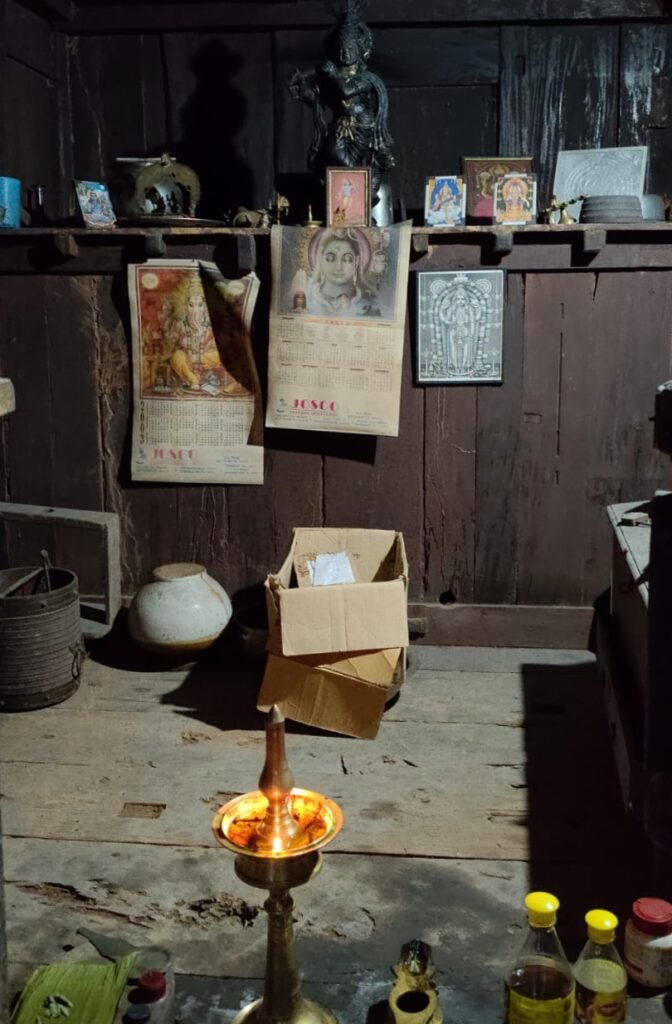
By the early twentieth century, however, this relationship was undergoing a sea change. This change was caused by colonisation and subsequent industrialisation on the one hand, and the rising resistance from Avarnas (enslaved castes) on the other. Lands were redistributed, families nuclearized, customs outmoded, and public practices like untouchability outlawed. As a result, the Savarnas were forced to find new ways to reassert their dominance. So they reinvented themselves as a new social class, the ‘neo-Savarnas’, with a reimagined set of customs and rituals (Devika 2020).
Drawing from the frameworks of scholars and anti-caste reformers, Gail Omvedt (1994) has noted that the practices relating to use and distribution of resources, such as endogamy or marrying within one’s caste, constitutes the material aspect of the caste system. At the same time, the concept of ‘purity and pollution’ has been used as an ideological mask which legitimises and retains these practices over changing socio-economic conditions. So what is this purity? Sundar Sarukkai (2009) has argued that purity is not a category in itself; it is defined relationally: purity is that which is not impure. It is those in power who get to define what is pure and impure. Brahmins–who occupy the ultimate position of power in the Indian caste system–identify themselves as ‘pure’, not by some inherent virtue, but by imparting whatever they consider ‘impure’ to those over whom they seek to assert their superiority. The impurity attributed to the ‘lower’ castes is associated with the occupational roles they are hereditarily bound to in a hierarchical social structure. Similarly, impurity is also attributed to the female body by reducing it to a mere instrument for reproduction and male pleasure. By exempting themselves from all these profanities of production (manual work, material creation) and reproduction (childbearing, caregiving, and other domestic labour), the Brahmin male remains pure and gains exclusive rights to perform sacred rituals. So, the idea of pure and impure may be understood to be consistent with the idea of sacred and the profane.
As someone from the Namboothiri community who grew up in the 90s, constantly moving between the semi-joint family setup of my rural ancestral house and an urban nuclear apartment, I’ve been privy to these practices of purity (that is, its revised modern variant) in both contexts. In my ancestral house, women are treated as temporarily untouchable during the first three days of their menstrual periods; they are exempted from doing household chores and restricted from accessing the kitchen and the front-door area. These restrictions were justified by the presence of the paradevatha that pervaded the house.
In traditional Savarna homesteads of the feudal era, rituals were not confined to a single room, but spatially distributed across the entire domestic compound (Nayar 2022). The purity of the household was thus maintained by literally pushing to the margins those bodies that engaged in production and in reproduction. The bodies of Avarnas (who performed most of the labour in the feudal system) were spatially excluded by social practices like untouchability and unapproachability. Pregnant and menstruating women were segregated in separately built wings of the house. The rest of the residents also had to go through routine purificatory rituals throughout the day. These houses also had multiple outward opening doors which allowed the residents to remove themselves out at once in the event of imminent pollution (which involved acts such as touching a broom etc.) and take a ritual dip in an adjacently built kulam (bath-tank).
However, the sacred/pure cannot exist independently without the material support of the profane world. Thus, the Savarna homesteads were carefully designed to juxtapose these categories within the domestic sphere, at the same time connecting and separating them.
 In the nuclearized households of the neo-Savarnas, which predominantly began to depend on the uninterrupted labour of the house-wife and house-help (whose low-caste status is tacitly assumed) could no longer sustain the presence of the sacred throughout the household. This resulted in the conception of an exclusive spatial niche within the house dedicated to worship: the pooja room/area. Entry to the pooja room is usually restricted to family members, and even within the family, women are routinely excluded during their menstruation. Thus, the pooja room enabled a ‘reverse quarantine’ of the sacred—it is now the deity that is confined to a zone of the house while the ‘impure’ bodies roam more freely. The lack of exclusive scriptural references to the pooja room testifies to its novelty. Yet, there are online and offline ‘vastu experts’ nowadays who try to integrate this modern invention with tradition through dedicated YouTube channels and home magazines. At the same time, this integration is also contested in the same space, with traditional commentators contesting such ‘modern’ tendencies. These, again, are experts (mostly Brahmins) who advise people against installing idols and performing poojas within domestic setups, by invoking scriptural references on purity. I recently came across a youtube video in which one such expert—the renowned Kanippayyur Krishnan Nambuthiri—says that the word pooja room is a misnomer and a proper term to explain such spaces would be something ‘simpler’ like ‘prayer room’.
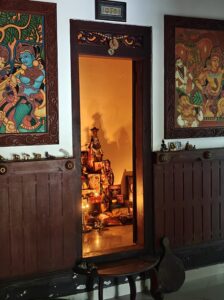
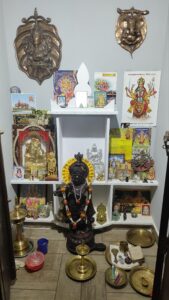
The Sanskrit word pooja refers to ritual acts such as offering flowers, food, or light to an idol/deity. The authority to perform poojas was traditionally reserved for Brahmins. While this continues to remain the case in the public context of temples, the neo-Savarna restructuring allowed Kerala’s intermediate castes (Sudra groups) to carve out a privatized right to perform pooja—a right still denied to them in the public-religious sphere. Until then, their domestic acts of worship were limited to practices such as namamchollal (praying) or lighting the lamp. These, most often, were carried out within the ummaram (front area), turning it into a provisional worship space. The modern pooja room (/area) functions as a showpiece which is viewed as having innate sacred value, detached from the human labor that produced it. It displays the family’s ‘proximity with the sacred’ and, in effect, their high-caste status. Something that I’ve personally noted is that the Nambuthiri families, when compared to others, are less invested in maintaining private pooja rooms. This is probably because their inherited ritual authority remains largely uncontested.
The dynamics of the modern pooja room is also gendered. Notwithstanding the menstrual taboos, the onus of attending the sacred in these households often seems to fall on women. For example, in many households, a woman stays vegetarian to retain the family’s ritual purity. Signs of this historical shift within the Sudra groups can be observed from Madhavikutti’s ‘Neermathalam Poothakalam’. She recounts how, until her previous generation, a Namboothiri priest was brought in to her ancestral house in Malabar to attend to the family deities, whereas at her house in colonial Calcutta, in which she spent her childhood, it was her mother who did the pooja. With servants to take care of other household chores, her only domestic responsibility was to attend daily to the pooja room.
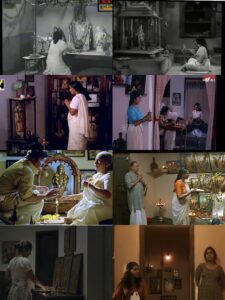
Apart from caste and class status, factors such as the time demands of modern jobs, the type of home, limited space and how religious the residents are also determine the scale and grandeur of pooja rooms. When faced with such material constraints, families often partially or completely outsource the sacred to a nearby temple. The domestic expression of sacredness, the pooja area, is either totally forsaken or kept minimal. Each neo-Savarna family identifies itself in affiliation to a clan temple (kudumba-kshethram). I have heard of multiple incidents within my kin networks of family deities being moved to the kudumba-kshethram when the family could no longer afford the ritual demands.
 Recently, an elderly relative of mine who lives alone in her newly bought apartment told me she doesn’t have a pooja area anymore. ‘It takes effort, and I’ve got bad knees’, she told me. ‘Besides, what’s the point when there’s a temple right across my balcony!’ Another relative of mine casually told me how her worship practices have recently turned virtual. She is a member of a WhatsApp group that comprises exclusively of antharjanams (Namboothiri women). It felt like a peek into a parallel world, when she explained how the group functions. Members share voice-notes or videos of them chanting mantras/bhajans, but not randomly. Each day is dedicated to a specific deity: Mondays for Shiva, Tuesdays for Bhagavathi and so on. The posting times are also strictly regulated to specific morning and evening windows. The admin marks these hours by posting readymade video-snippets of a sreekovil door opening and closing in slow motion, with the added sound-effects of the ceremonial bell and the conch. Essentially, the group seeks to simulate a temple-like ambience and offer a virtual experience of community worship.
With the pooja room or lack thereof, neo-Savarna domesticity consistently tries to position itself in relation with the sacred, by looking up to the temple—either an outsourced service provider, or as an aesthetic and ritual anchor. This is because these temples, (which, again, are usually managed by upper-caste groups) continue to retain pre-modern notions of purity and caste-based ritual authority, with the Brahmins at the top and intermediate castes in subordinate roles (Roopesh 2017). Historian J. Devika (2020) has observed how this neo-Savarna domesticity, with its inherent gendered and caste-ridden implications, contributed to the rise of right-wing mobilization of women in 2018 against the Supreme Court’s verdict allowing women of menstrual age to enter the Sabarimala temple, where it had long been forbidden.
If we hope to challenge such public and spectacular forms of right-wing dominance that are emerging in Kerala, I think we need to also understand its less visible expressions, such as the modern pooja rooms. Looking at the seemingly innocuous pooja room, its functional adaptations, and the historical forces that shaped it, would shed some light on how dominant castes of Kerala continue to sustain the dichotomy between the sacred and the profane, within the domestic sphere, to retain their social hegemony.
References
Bhattathirippad, V. T. (1970) 2012. Kanneerum Kinavum. Reprint, Kottayam: DC Books.
Devika, J. 2020. ‘The Defence of Aachaaram, Femininity, and Neo-Savarna Power in Kerala’. Indian Journal of Gender Studies 27 (3): 445–470. https://doi.org/10.1177/0971521520939283.
Madhavikutty. (1993) 2012. Neermathalam Pootha Kalam. Reprint, Kottayam: DC Books.
Manorama Online. 2016. ‘Veettil Pooja Muri Doshamo?’ [Is a Pooja Room at Home Inauspicious?] Manorama Online, 1 February 2016. https://www.manoramaonline.com/astrology/vastu/pooja-room-tips.html#
Musath, Thirumangalathu Neelakanthan. (16th cent.) 1928. Manushyalaya Chandrika. Commentary by K. Parameswara Menon. Thrissur: Kochi Bhasha Parishkarana Committee. Internet Archive. https://archive.org/details/ManushyalayaChandrika.
Nandakumar, R. 2022. Insight and Outlook: Selected Essays on the Contemporary Art of Kerala. Thrissur: Kerala Lalithakala Akademi.
Namboothirippad, Kanippayyur Krishna. 2021. ‘Pooja Muriyude Sthaanam’ [The Placement of the Pooja Room], YouTube, 5 December 2021. https://youtu.be/1dW-pZsr0aA?si=G-KsOqKb2LLHluGT
Nayar, Devi. 2022. ‘House as Ritual: Stories of Gender, Space, and Caste in Colonial Kerala’. Unpublished Masters Thesis, Yale University. https://elischolar.library.yale.edu/envdesign/6
Omvedt, Gail. 1994. Dalits and The Democratic Revolution: Dr. Ambedkar and The Dalit Movement in Colonial India. Sage Publications.
Prabhu, Balagopal T. S. n.d. ‘Kerala Architecture’. KCHR Publications. Retrieved from the Internet Archive. https://web.archive.org/web/20110721082519/http://www.keralahistory.ac.in/keralaarchitecture.htm
Roopesh, O.B. 2017. ‘Temple as Political Arena in Kerala’. Economic & Political Weekly 52, no. 16. https://www.jstor.org/stable/26695843
Sarukkai, S. 2009. ‘Phenomenology of Untouchability’. Economic & Political Weekly 44, no. 37, 39–48.
_________________________________________________________________________________________
About the Author:
Gautham is BAMS graduate who pursues art and cultural history out of personal passion. He enjoys listening and gathering lived stories and personal memories. Hoping to ground his observations in broader academic frameworks, he is currently doing his Masters in Folklore and Culture Studies from IGNOU. This is his debut essay.


