
From separate tumblers to inaccessible dining tables, Silpa Anirudhan examines how Malayalam cinema archives the everyday life of caste in Kerala’s domestic spaces. By reading culinary practices across films from different decades, she reveals how untouchability survives not as spectacle but as an ordinary, intimate, and enduring social order.
Silpa Anirudhan
“കുപ്പമാടത്തിലൊതുങ്ങേണ്ടവൾ
തീണ്ടി നിൽക്കുന്നു മുന്നിൽ
അഹങ്കാരരൂപിണി
ആദ്യവെള്ളിത്തിര കീറി
മേലാളന്റെ ധാർഷ്ട്യം വിധിച്ചു
കൊടും പാപിയാണിവൾ
വേശ്യ”
(Nadiyude Rathri, Kureeppuzha Sreekumar)
Sreekumar’s poem Nadiyude Rathri (2023) documents how untouchability extended from Kerala society into the cinematic space during the screening of the first Malayalam feature film, Vigathakumaran (1930), at the Capitol theatre. That day, upper-caste men violently tore P.K. Rosy, the heroine of the film and a Dalit Kaakarashi artist, off the screen and from her village for the ‘sin’ of playing a Nair woman. Today, amidst the attempts to recuperate P K Rosy through novels, films, poems, articles, and documentaries, the question of “How much space can a Dalit body access, if not assert, in Kerala’s domestic and cultural space” remains. Even after a century of ‘Panthibhojanam’ (communal feast) and the emergence of the ‘secular’ public sphere, the structural rigidity of the caste system in Kerala persists in culinary spaces, as it does in matrimonial and obituary columns.
Caste, at times, infiltrates our lives through tiny utensils and everyday practices. We have grown up in households with exclusive kitchen racks stacked with white crystal crockery with exquisite floral detailing, waiting to serve guests, worthy and dignified, to feast from them. In most homes, those guests are yet to come, and the crockery still longs for their grand arrival. Have we ever addressed the fact that this tasteful domestic corner is quietly propelling caste? Dining tables are reserved for upper-caste and class individuals, while the caste-oppressed remain uninvited to ‘pollute’ the interiors. Malayalam cinema, perhaps unintentionally, reflects this caste positioning by drawing an invisible boundary between the savarna culinary space and the ‘untouchable’. In this essay. I trace the restricted access of the caste-oppressed in Kerala’s domestic spaces, their attempts to reassert culinary space, and its reflection in Malayalam cinema.
Two Tumblers: Pure and Polluted
Looking closely, the ‘two tumbler system’ (Gorringe H., & Muthuswamy M.) was normalised in early 20th-century Malayalam cinema. As Diya Joseph points out in her article, “the ‘untouchables’ ate and drank in utensils like kavadi kinnam, irumbu kinnam and ottu kinnam”, which were considered polluted because of their association with the caste-oppressed (2021). Adiya labourers in the movie Nellu (1974) and Paniya labourers in Oppol (1981) were given food in banana leaves and ‘irumbu kinnam’ in the Savarna kitchen backyard, and the scenes are normalised. The audience felt resentment when heroes like Sudhi (Aye Auto, 1990 (1:22:04), an auto driver played by Mohanlal, and Premachandran (Aniyan Bava Chettan Bava, 1995), a car driver played by Jayaram, were removed from the familial dining space. On the other hand, Pattanapravesham (1988) brushes aside a similar scene as comic relief where Thankappan, played by Srinivasan, and the domestic help were given food in the kitchen’s backyard (01:22:01). Movies such as Thenmavin Kombath (1994) and Kaikudanna Nilavu (1998) normalise this act of forbidding a lower caste’s entry to the interiors of a savarna household and its dining table. In Thenmavin Kombath, “Kannayyan”, the hero’s father played by Sankaradi, is dining in the backyard, where a domestic help is cleaning the vessels and cattle are grazing (00:18:22). Likewise in Kaikudanna Nilavu, Lakshmanan the hero’s close friend played by Kalabhavan Mani is dining outside the kitchen and has to plea for a fish fry but fail to get it (00:55:36); Kannayyan and Lakshmanan are oppressed in subtle ways despite their close relationship with the heroes. These representations underscore the dining area’s intrinsic connections to caste, making it a space of ‘non-belongingness’ for the lowered-caste characters.
If the aforementioned examples suggest this is a portrayal reserved for the last century, the more recent Madhura Manohara Moham (2023), a satire set in a Nair household, presents numerous instances that unfold the subtle yet underlying caste disparities in Kerala society today. Usha, the matriarch of the family, epitomises the casteist disposition and clings to the memory of a bygone era. The fish seller woman appreciates Usha for her generosity, such as providing her with black tea every day, sitting with her, and gossiping about the neighbours. The character is not given a name, apart from her identity as a fish seller. She is oblivious to the underlying caste implications in her interactions with Usha; the fisherwoman is welcomed into the backyard of the house, not at the entrance or in the interior. Their sitting posture reinforces the hieratic scale; Usha is seated on a small stool, whereas the fisherwoman is on the verandah, implying Usha’s dominance. Usha pours her black tea into an old steel tumbler reserved for lowered castes, which contrasts with the glass tumbler used by the family (00:20:25). The stark contradiction strikes us in Usha’s encounter with Shrishankar, the grandson of a distinguished upper-caste family. Her aspiration for a marital alliance between her daughter and Shrishankar culminates in preparing an elaborate milk tea for him. She adds cardamom to enrich the tea’s flavour, pours it into the brightest white cup and saucer, safeguarded in the cupboard (00:32:36). Usha grants Shrishankar access to the house’s interiors and wishes for social elevation immediately after he explains his lineage. In the meantime, she fears the prospect of contamination through the fisherwoman’s body and intentionally refrains from any close contact with it.
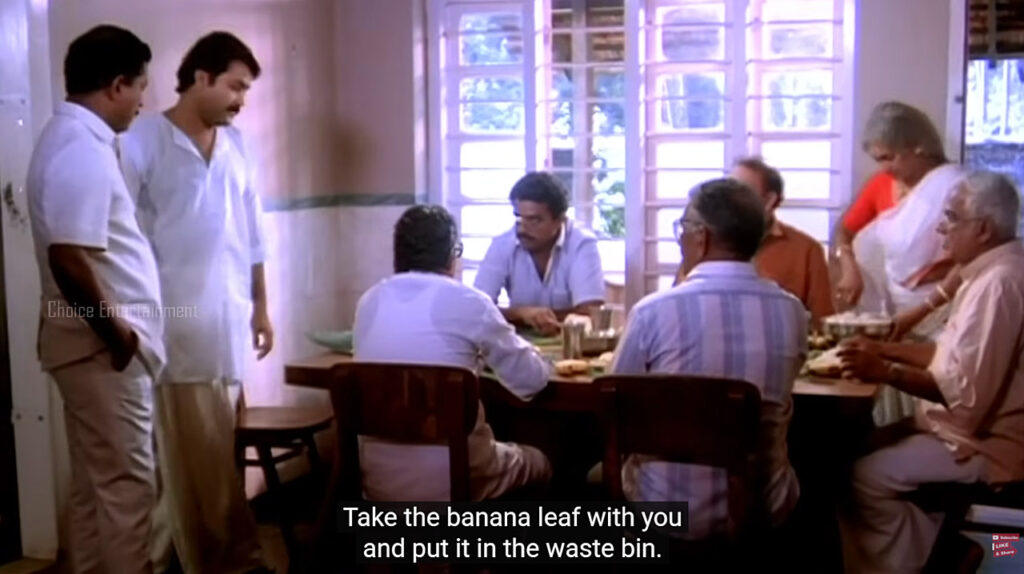
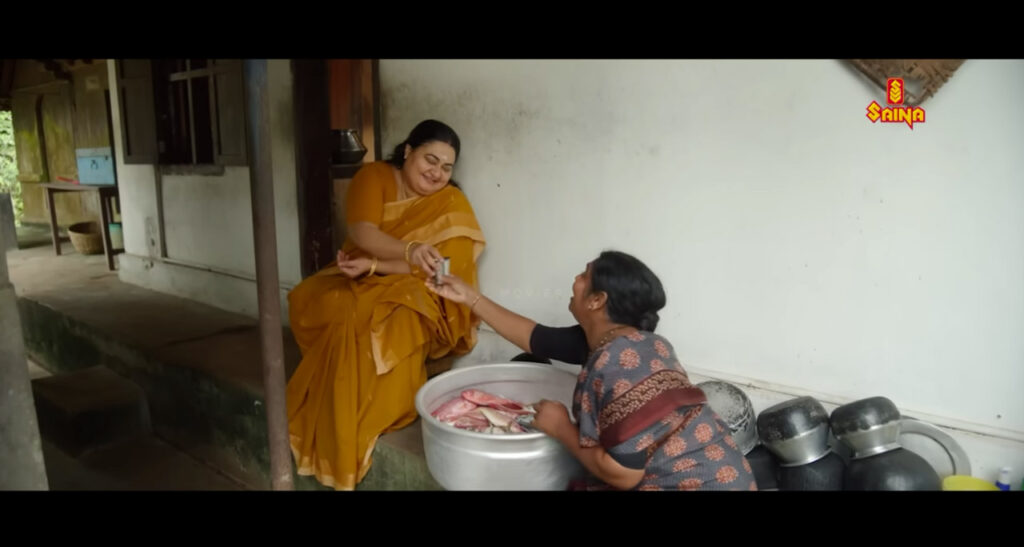
In Manassinakkare (2003), the food prepared by Kunjumaria, a working-class woman, is conceived as dirty and unhealthy in the elite household. They dump the snacks and savouries as a preventive measure to ‘avoid diseases’. Ration (Klipthavihitham), one of the five-film-anthology Freedom Fight (2022), unfolds economic disparity between neighbours through culinary exchanges. For instance, the lower-middle- class housewife packs a major share of the food from her house party, the best pieces of chicken curry, chapati, and the cake pieces in the best casseroles to share with her ‘high-class’ neighbour, while other neighbours get the leftover cake pieces in used ice cream tubs and steel vessels (01:20:10). These instances illustrate how culinary artefacts serve as carriers of caste and class.
The 2022 movies Puzhu and Pra.Thoo. Mu (Prajapathikku Thooran Muttiyappol) (from the anthology Freedom Fight), show a substantial critique of caste-based violence in domestic spaces. They consciously project the lowered-caste person’s assertion of domestic space and how disturbing and rage-inflaming it is to upper-caste society. Puzhu portrays multiple instances of culinary caste discrimination, for instance, the portrayal of grumbling upper-caste residents, including Kuttan played by Mammootty, when a delivery boy brings non-vegetarian food to the flat. Kuttan reprimands his sister Bharathi’s entry to the apartment since she married Kuttappan, a Dalit theatre artist. He violently eliminates them, fearing their attempts to reassert space in his domestic order. Another character, CK, performs a casteless life, shortens his name, renouncing its caste baggage, but never eats from Kuttappan’s home. Characters such as Kuttan and CK unveil how deep-rooted caste is. Their behaviour exhibits the fear of defilement of a performative-casteless society, which holds caste in its interiors and culinary practices.
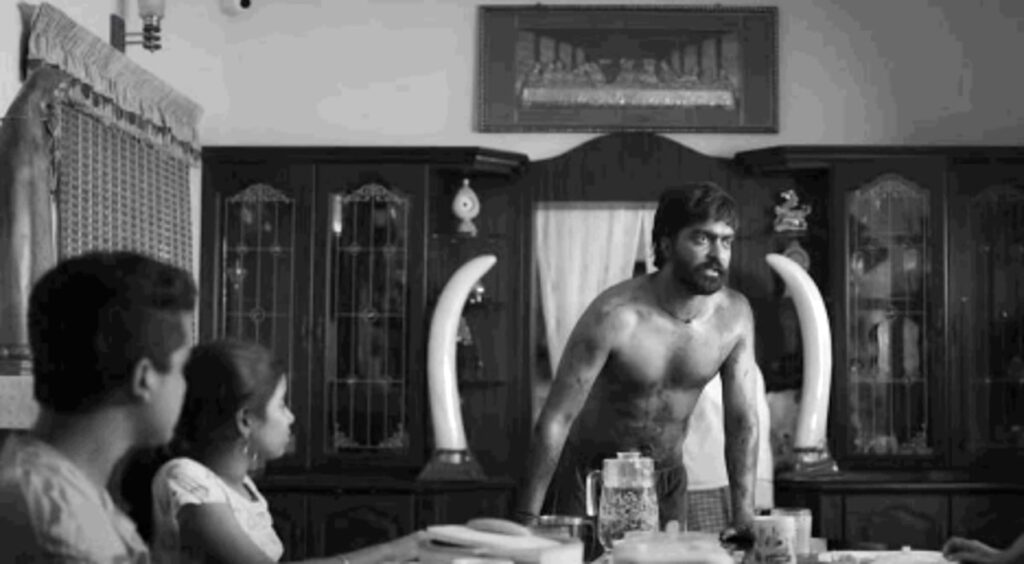
While Puzhu closely follows Kuttan, the savarna oppressor, to unravel violence associated with caste purity, Praa. Thoo. Mu displays the brutal attack faced by Lakshmanan, a manual scavenger, and becomes another gruelling representation of unaddressed caste violence in Kerala. The ‘emperor’ and his entourage could not digest Lakshmanan’s invasion of their dining area, which triggered the attack (-00:23:37). The gruesome onslaught on him reminds us how caste continued to remain active in closed circles and private spaces even as secular ethos were shaping Kerala’s public sphere (Harikrishnan, S. 2020). The camera positions Lakshmanan at the centre of the dining table, forcing the savarna to look up at him, signalling his authority in the scene. They flinch at the sacrilege resulting from their proximity to the human waste on him, and ‘the waste that he himself is’. This is in contrast with the visual positioning of Usha and the fisherwoman in Madhura Manohara Moham (refer clips 2 & 3). Lakshmanan’s entry to the interiors echoes a Dalit’s abject presence and their resistance by imprinting his footprints on the savarna floor and palmprints that banged on their dining table. Praa. Thoo. Mu conscientiously unmasks the caste hierarchy and violence disguised in the secular state. It leaves the shrill cry of resistance despite the emperor’s attempts to mute it!
Films like Puzhu and Praa. Thoo. Mu portray the violent depth of culinary caste discrimination in private spaces rather than normalising it or making it a laughing stock. Contemporary Kerala society may not serve kanji to the caste-oppressed in leaves spread in mud pits, or clay pots, not because caste is erased. It has simply been repackaged—into steel tumblers and scrapped ice cream tubs, quarantined from the rest of the household’s vessels. Those vessels are exclusively allotted to the lowered-caste friends, whom the savarna meet and greet at the verandah or the kitchen backyard. They shake hands with the ‘other’, embrace them, carefully enough not to touch their skin. Savarna visits the low-caste’s homes, but never dines there. The upper-caste home retains its ‘purity’ by maintaining restrictive access to its culinary spaces. As Harshad, Puzhu’s screenwriter, rightly points out in his interview with Maktoob media, it is a blatant lie that there is no caste in Kerala. It disguises itself, holds its ground, and draws invisible territories around the kitchen and dining areas—vigilantly keeping the outcast out of the house.
References
- Gorringe H., & Muthuswamy M. “The politics of caste and the performance of resistance: Separate tumblers in Tamil Nadu”. Contributions to Indian Sociology, Vol. 47 No. 3. 409–432. 2013
- Harikrishnan, S. “Negotiating Caste: A Matter of the Public and the Home”. Inter-actions, Vol. 2. Qtr. 4. 2020 https://lilainteractions.in/negotiating-caste-a-matter-of-the-public-and-the-home/
- Joseph, Diya. The Caste Stories Behind Kerala’s Traditional Cookware. Goya. 2021. https://www.goya.in/blog/the-caste-stories-behind-keralas-traditional-cookware
- Kayyalakath, Aslah. “It is a blatant lie there is no caste in Kerala: Puzhu writer Harshad”. Maktoobmedia. 15 June 2022. https://maktoobmedia.com/public/post?id=50471&slug=it-is-a-blatant-lie-that-there-is-no-caste-i n-kerala-puzhu-writer-harshad
- Sreekumar, Kureepuzha. “Nadiyude Rathri”. Janayugam. 2026 https://janayugomonline.com/kureepuzha-sreekumars-poem-nadiyude-rathri/
Films
- Vigathakumaran(1930) dir: J C Daniel
- Nellu (1974) dir: Ramu Kariat
- Oppol (1981) dir: K S Sethumadhavan
- Aye Auto (1990) dir. Venu Nagavalli ; Link : https://www.youtube.com/watch?v=mw5xT6q7ofA
- Aniyan Bava Chettan Bava (1995) dir. Rajasenan ; Link: https://www.youtube.com/watch?v=XQ_qKdgg4Vo
- Pattanapravesham (1988) dir. Sathyan Anthikkad
- Thenmavin Kombath (1994) dir. Priyadarshan
- Kaikudanna Nilavu (1998) dir. Kamal
- Manassinakkare (2003) dir. Sathyan Anthikkad; Link: https://www.youtube.com/watch?v=JR0klKevHtk
- Puzhu (2022) dir. Ratheena P.T
- Ration (Klipthavihitham) (2022) dir. Francies Louis
- Pra.Thoo. Mu (2022) dir. Jithin Issac Thomas
- Madhura Manohara Moham (2023) dir. Stephy Zaviour
About the author: Silpa T Anirudhan is a research scholar and an ICSSR Fellow in the Department of English and Cultural Studies at Christ (deemed to be University), Bangalore. Her areas of interest include Folkloristics, Tribal Studies, and Cultural Studies.


