
Shruthi Ramesh delves into the politics of public space at Payyambalam Beach, exploring how access and the right to shape it remain unequal, shaped by labour, gender, climate change, commerce, and institutional power.
Shruthi Ramesh
The Payyambalam beach is a welcoming space. Especially during the late evenings, it comes alive as beachgoers (the “primary users”)– men, women and children in groups– throng its sands, drawn by opportunities of leisure and consumption, and the allure of the beach’s unboundedness. As leisure entangles with labour, livelihood and environmental precarity along the coastline, though, the question shifts from whether there is a place for everyone to whether everyone has the time, resources and freedom to lay claim to it and reshape it.
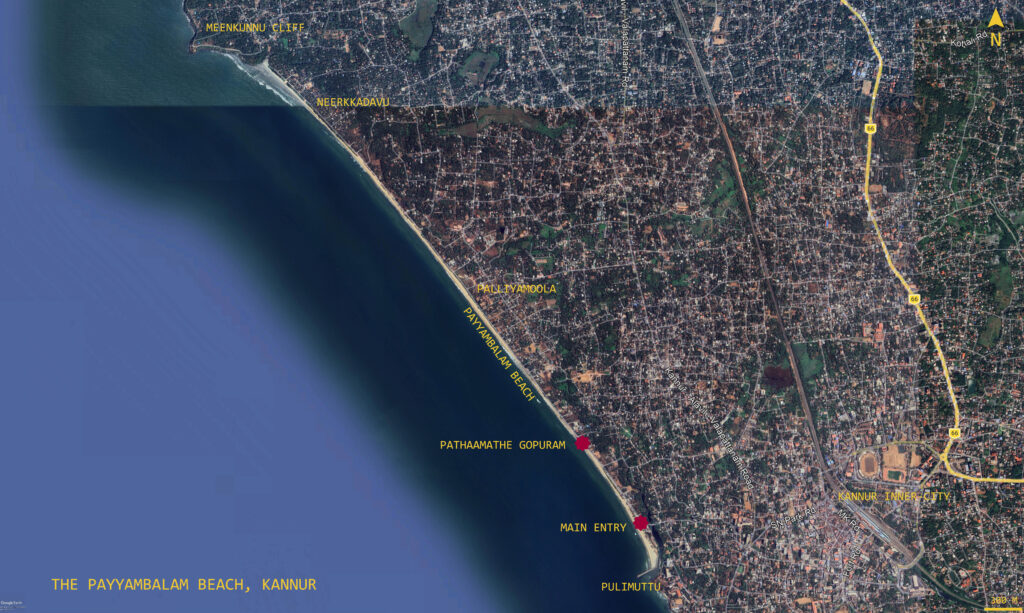
In Beach Politics, Setha Low (2025) positions that as long as the beach is public, “there is always a place for them [beachgoers]”, an idea she complicates by examining the highly conditional nature of access and belonging. Drawing on field observations and conversations at Payyambalam beach, this piece records the voices of multiple stakeholders–including but not limited to–the “beachgoer”.
Who defines the beach?
Although beachgoers experience the sandy beach, park, coastal road, state-run crematorium, vendors, and private businesses along the beach as one beach precinct, ownership and management– and consequently, spatial claims on the beach’s physicality– remain institutionally fragmented. The sandy beachscape and park come under the District Tourism Promotion Council (DTPC), whereas the coastal road falls predominantly under the Kannur Municipal Corporation, with its northern stretch under the Azhikode Grama Panchayat.
“The beach is primarily situated on unsurveyed land”, notes an official with the DTPC Kannur, the government-run trust under the Department of Tourism which manages the upkeep of Payyambalam Beach. This further complicates the trail of ownership. “We face significant difficulties in executing and placing permanent built structures, such as public toilets and other essential facilities within the beach premises. The Coastal Regulation Zone (CRZ) guidelines add an additional hurdle to this process”, he adds, reiterating challenges to the addition of built interventions within the beach. A pavilion proposed as a part of the Payyambalam Beach Walkway Project (2012 to 2019) also remained unbuilt amid CRZ restrictions and difficulties associated with building on unsurveyed land.
A range of uniformed custodians, including lifeguards, the Coastal, Tourism and Pink Police divisions, and the Kudumbashree Payyambalam unit of cleaning staff, oversee the beach’s management, surveillance and upkeep. The operational extent for physical management across the beach space was delineated differently by each custodian. For instance, one of the eight Kudumbashree staff assigned to clean the vast spatial expanse describes their spatial jurisdiction as:
“Avidunnu thudangikkazhinjaal nammal aa pathaamathe gopuram vare… […] clean cheythittu varum.” (Translation: starting from there [near the pulimuttu], we go all the way up until the 10th gopuram– meaning rain shelter here– and clean). As far as the eight cleaners are concerned, this large expanse becomes especially tedious to clean during the Friday to Monday timeframe.
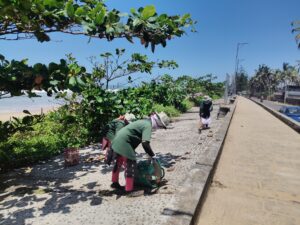
Typically, this operational extent covers approximately 1.4 kilometres along the linear expanse, from the recently built pulimuttu (groyne) to the 10th rain shelter, which marks the end of the 1-kilometre-long elevated walkway. This is reinforced by the inlay of spatial infrastructure, such as lighting, paved walkways and rain shelters, as limited to this extent, while the uninterrupted sandbar stretches across approximately 5.5 kilometres from the pulimuttu until the Meenkunnu cliff. Here, infrastructure governs access.
Fishermen trace the geographical extent to which their boats venture into the sea by measure of nautical miles. Larger boats traverse 20-22 nautical miles seawards, whereas smaller boats, such as the ones docked at Neerkadavu (the fishing village stretch), journey around 6-7 nautical miles. In contrast, governmental documents adopt a metric vocabulary while specifying that the first phase of the walkway project covered an expanse of 260 metres and the next 800 metres.
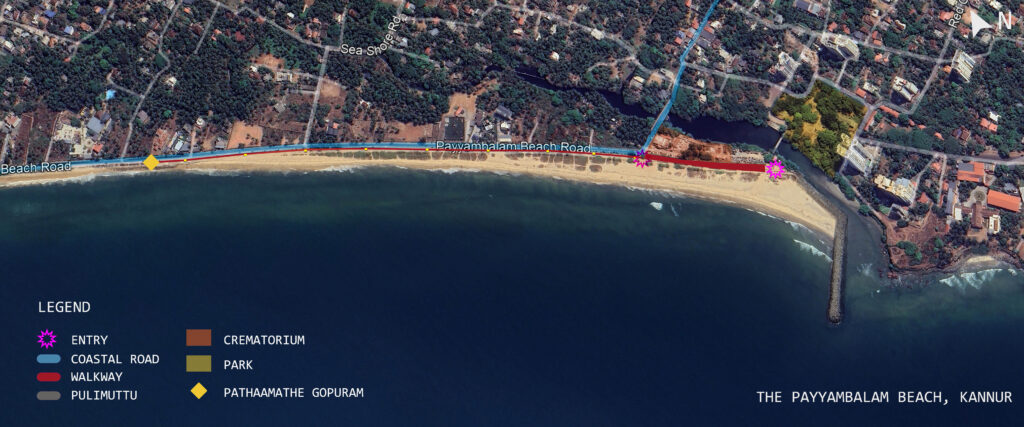
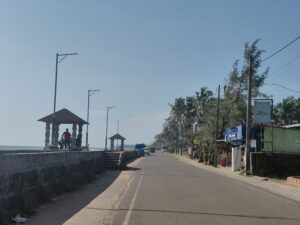
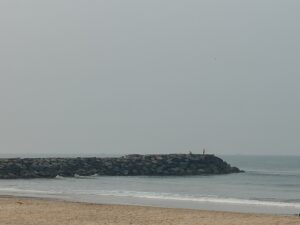
These different extents reveal that the same spatiality is not measured through a single vocabulary but is experienced, measured, named, imagined, and bounded differently by different actors. Beyond the Kudumbashree workers’ labelling of the walkway endpoint as the “pathaamathe gopuram”, a state official refers to the perpendicular random-rubble structure extending outwards to the sea at the beach’s southernmost edge as pulimuttu, jargon for a type of coastal protection structure. Given its dominant visual presence framing the spatial edge, one wonders whether an apt name has emerged for it in local parlance. Notably, the stretch between the pulimuttu and the pathaamathe gopuram is also where the responsibilities of the lifeguards, police and Kudumbashree cleaners, and infrastructure are concentrated.
Who can hold on to the beach?
Erosion complicates spatial claims by altering the physical ground over which they are made. With large chunks of the sandscape eaten away, the disappearing sandbar becomes a major cause for concern, especially for the fisherfolk community, who experience difficulty docking their boats, and subsequently, sustaining their livelihoods.
“Pandu kadal ithra aduth aayirunnilla. Athu keri keri ippol ivide ethi… pandu […] oru randu moonu kilometre vare neendu kidappundaayirunnu.” (Translation: In the past, the sea wasn’t this close. It keeps advancing, and now it has reached here… Back then, it (the sand bar) extended for about two or three kilometers), a fisherman and local resident of Neerkadavu, a fishing village and enclave located towards the Northern end of the beach, recollects. As an experienced fisherman, he adds that the receding shoreline currently observed is partly seasonal and there are seasons when boats can be docked directly on the sandbar.
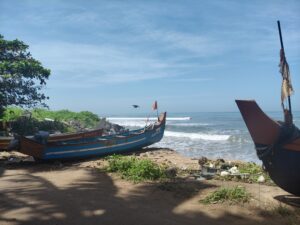
Climate change adversely affects beach access and usage, with the diminishing sandy expanse impacting livelihood and everyday practices of the fisherfolk tied to the beach. Cohen’s argument, “climate justice is the right to the city” (Cohen, 2018, as cited in Wagle and Philip, 2022) offers a useful lens through which coastal vulnerabilities could be considered. Here, the right to the city extends beyond access to a public space, covering the ability to use coastal space for habitation and livelihood. How can livelihoods along the coast be sustained when the ground on which their claims stand disappears?
Who shapes the beach?
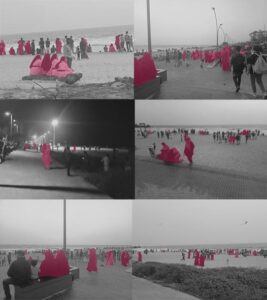
The unbounded nature of the beach makes it readily accessible as a public space, enabling different actors to walk, sit, loiter, play sports, work, sell, fish, and even patrol and surveil. It offers a space for leisure and play, extending itself as a therapeutic respite. This unboundedness is, however, experienced differently across diverse social groups. For women beachgoers, especially within the South Asian context, staking a claim in this space means navigating a complex web of cultural expectations, safety perceptions, and internalised fears. The beach thus becomes not simply a site of leisure but also one of gendered negotiation (Ramakrishna and Ramesh, 2021).
In their seminal work, Why Loiter?, Shilpa Phadke, Sameer Khan and Shilpa Ranade argue that “access to public space is dependent not only on the ‘permission’ to be in public, but also critically on the actual material infrastructure, which makes it possible to use these spaces.” (Phadke et al, 2011). This access is further regulated through time, social expectations and anticipated risk.
“Ee samayathu ottakku varunnathinu prashnamilla, pakshe rathri ithuvare angane vannittilla ottakku, athukondu ariyilla rathri enganeyaanennu” (translation: there is no problem with coming here at this time [5pm], but I have never come alone at night. So I do not know how it will be), a young woman replied, when asked if a woman can come to the beach alone. She quickly added that when with friends, she has stayed till 8 – 8.30 pm. Her account points to an invisible curfew, socially-imposed and partly self-regulatory, through which accessibility to the beach becomes temporally contingent. Even formal custodians such as police officials and lifeguards limit service to the beach past 8 or 9 pm.
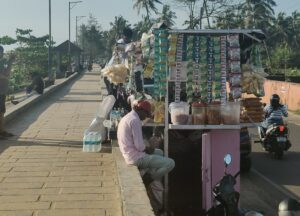
The beach precinct is also shaped by expanding commercial activity, where food, leisure and tourism extend their own spatial claims. Informal vendors extend spatial claims by occupying government-land along the beach’s edges, sandwiched between the beach and the coastal road. Kainottakkar (palm readers), hawkers and peddlers selling salted peanuts, kites, and other knick-nacks, and the occasional camel safari appropriate the sandy shores and walkways. Larger hotels and restaurants occupy privately-owned plots that face the beach and open onto the coastal road. These varying forms of commerce establish distinct socio-spatial relations with the beach.
In beach settings globally, private establishments often directly abut and control access to the shore (Cartlidge, 2011). Unlike in Varkala in Keralam or other public beaches in Goa where this is also observed, at Payyambalam, the spatial configuration complicates privatisation of the public beach.
“Beachile access nammakkum road cross cheythittu thanneya; nammalum saadharana aalkkaru pokunna pole thanneyanu access cheyya.” (Translation: Our beach access is also upon crossing the public road. It is the same way the average citizen accesses the beach), the Operations Manager at a 3-star beach resort at Palliyamoola abutting the beach observed.
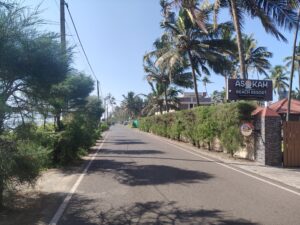
While the public coastal road might limit the ability of these private entities to claim exclusive control over the beachfront, softer claims over the territory are established by voluntarily landscaping and maintaining the beachfront edge across the road from their properties, guarded by security and surveilled with CCTV. While these establishments remain unable to formally restrict the public activities at play within the beachscape facing their properties, their management and surveillance are designed to deter anti-social activity from spilling into the beach frontage. Here, the intention of their spatial claims is not to assert ownership, but to control character and conduct within the public beachfront.
So, whose beach is it?
Upon being asked if he ever visited the beach with his family, a kach 1 vendor shook his head in refusal, adding that he mans the stall almost 7 days a week between 8 am and 11.30 pm. A Kudumbashree worker who cleans the beach from 8 am to 5 pm gave a more noteworthy response:
“Nammal ee raavile thottu vaikunneram vare full time […] kadalinodu malsarikkuaanu. Pinne namukku athu aaswadikkaanulla samayam namukkilla, athukondu nammal varuthilla”.
(Translation: We are working full time from morning to evening, competing with the sea. Then, when do we have the time to enjoy it [the beach]; so we don’t visit.)
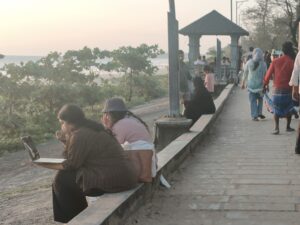 For individuals whose working lives unfold on the beach, it does not necessarily translate as a space they choose for leisure.
In his seminal work on the Right to the City (Le Droit à la Ville), Henri Lefebvre describes the “right to the city” as encompassing the right “to places of encounter and exchange, life rhythms and time uses, to enabling the full and complete usage of these moments and places, etc.” (Lefebvre, 1996, p 179). What we see in Payyambalam is not the exercise of full and complete public access, but rather an uneven realisations of said rights; with class,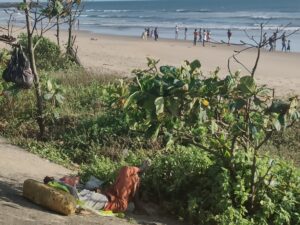 social status, occupation, gender, institutional and economic power as determinants.The state agency that manages the beach encounter restrictions in shaping it; the labour that maintains it is unable to belong in it; the fisherfolk that inhabit it are constantly tussling with it for space; the female beachgoer’s access and agency to it are temporal at best; and the commerce that brings vivacity to it is unable to secure firm claims on it. In other words, the beach may be open to all in principle, but the capacity to occupy it, enjoy it, and influence its future remains unequally distributed.
References:
Cartlidge, Nigel. “Whose Beach is it anyway?.” In Towards Liveable Cities and Better Communities. Smart Vision International, 2011.
Cohen, Daniel Aldana. “Climate Justice and the Right to the City.” University of Pennsylvania, Philadelphia (2018).
Lefebvre, Henri. Writings on Cities. Translated and edited by Eleonore Kofman and Elizabeth Lebas. Oxford: Blackwell, 1996.
Low, Setha, ed. Beach politics: social, racial, and environmental injustice on the shoreline. NYU Press, 2025.
Phadke, Shilpa, Sameera Khan and Shilpa Ranade. Why loiter?: Women and risk on Mumbai streets. Penguin UK, 2011.
Ramakrishna, Bhagyasshree, and Shruthi Ramesh. “Politics of Gender, Democracy and Public Space: Analysing the Gendered Socio-Spatial Production of Urban Beaches.” , (2021).
Wagle, Paroma, and Kavita Philip. “Climate justice is social justice: articulating people’s rights to the city in Mumbai.” Environment and Urbanization 34, no. 2 (2022): 331-348.
_________________________________________________________________________________________
About the author:
Shruthi Ramesh is an architect, urban designer and researcher based in Kerala. Her work explores how gender, class and caste shape experiences of the built environment, influencing who gets access to space, who feels like they belong, and whose needs are overlooked in the making of cities.


