
Native Ball playfully blurs fact and fiction through understated text and images, inviting readers to question how truth is constructed. Shubhra Dixit reflects on how Anup Mathew Thomas uses the familiar language of reportage to create a thoughtful, quietly intriguing portrait of place, memory and belief.
Shubhra Dixit
When I spoke to the Berlin-based artist Anup Mathew Thomas about his new book Native Ball (Reliable Copy and the DAAD Artists-in-Berlin Program, 2025), I fixated on whether or not it was a journalistic project. I tried to convince him that it was; he argued the opposite. Thomas suggested that if I had encountered the work in a gallery, I would have read it differently. I insisted that the text felt like reportage. We arrived nowhere, which feels right for a work that slips away from a strict definition.
In hindsight, I realise we were probably talking about different things. I was referring to the book’s tone, which bears the cadence of news writing, the flattening of human events into crisp, impersonal paragraphs. Thomas, meanwhile, took ‘journalistic’ as a literal category, bound by its own rules. That slippage, between tone and category, is central to how Native ball works.
For someone encountering Thomas’s work for the first time through the book, as I did, the temptation is to take it at face value. The oddness of the stories does not immediately register because they are written with bureaucratic confidence. When we first spoke, he asked me: ‘Why would you believe these to be true?’
It’s a simple question that throws the book’s mechanism into focus. The book itself is not working especially hard to deceive; the insistence on truth comes as much from the work as from the reader’s instincts – the reflex to treat anything that looks like a record as evidence.
This concern with belief, documentation and narration runs through Thomas’s practice more broadly. An artist from Kerala who works with photography, text and narrative, Thomas has consistently returned to the region as both subject and framework. Among his earliest projects was Well, Basically This is About Thomas Jacob (2003), a two-channel digital slide show centred on his father, a journalist, portrayed at work, and in scenes of domesticity and candour. From there followed a series of projects set in Kerala—Metropolitan (2006), Cabinet (2007), and Nurses (2014)—each attentive to everyday institutions, professions and events. More specifically, Thomas is interested in ‘people and how they behave’.
Across many of his projects, Thomas has worked with text and image in tandem, arriving at his current format through a process of trial and error. Text is used sparingly and kept at a distance from the images, and he is firm that he does not want to guide viewers on how the work should be read. He does not conduct walkthroughs or explain intentions. What he will say is that he is interested in what happens in the gap between image and text. He neither confirms nor denies most interpretations; the work exists, and meaning is left to emerge in the encounter between image, text and viewer (or reader).
Native ball brings together four earlier projects: View from Conolly’s plot (2010), Hereinafter (2012), Native ball and revisions (2014) and Scene from a wake (2016). On the surface, the book appears to function as a documentary record of the region, combining the authority of text and image to present what initially reads as truth. At the same time, it has the feel of a cabinet of curiosities, recalling the ‘incredible-but-true’ compendiums of childhood.
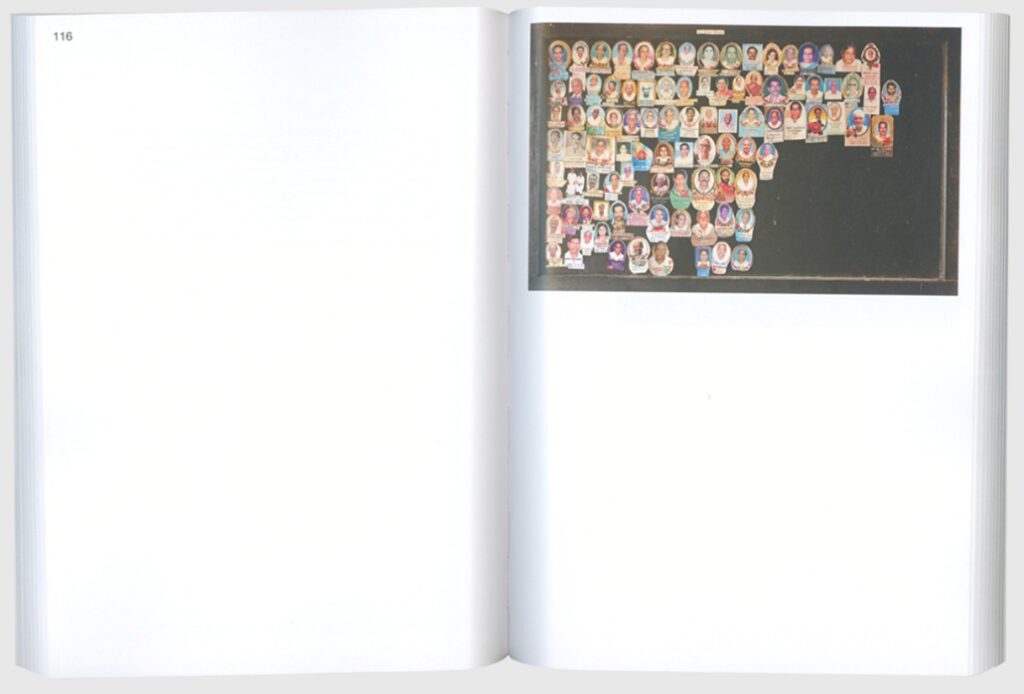
Native ball is composed of fragments of stories from Kerala: a photographic image printed on one page, followed by a text plate on the next, first in English and then in Malayalam. Image and text do not face each other. Instead, the reader must turn the page, carrying a memory of what they have just seen into the story that follows. That lag allows the image a moment to sit in the mind before the words arrive to animate it.
Thomas describes the book as, ‘a hybrid of sorts. It is a story book, a collection of documents, and works, possibly even as a catalogue’. It was the publisher at the Bangalore-based Reliable Copy, Nihaal Faizal, who felt that the pairing of text and image lent itself especially well to the book form. Across 43 colour plates and 33 text plates, Thomas builds a portrait of a place and its people that is bureaucratic, deadpan and often darkly funny.
Each of the book’s four component projects moves through a different register of public and private life, touching on legal disputes, property, death, religious ritual, accident and rumour. View from Conolly’s plot lingers on Kerala’s attempts to reconcile its past with its present. Hereinafter turns inward, to death and remembrance, following bridges, memorial plaques, private biology museums and pre-staged coffins. Native ball and revisions stays with the local ball game that gives the book its name, as well as with the introductions, revisions and quiet failures of various ‘new practices’ and art projects. Scene from a wake moves through religious ritual, paying particular attention to the errors, economies and ironies embedded within ritual. In one instance, it points us to a sculpture of the Madonna modelled on local fisherfolk that is rejected by the congregation it is intended for as being ‘too dark and ugly’ to stand in for the mother of Christ.
Thomas is clear that he is not interested in accuracy or in presenting facts. What interests him instead are stories—many of them, in the case of the projects featured here, sourced from newspapers, which he intentionally seeks out and builds upon. ‘Everything is very carefully crafted’, he told me, ‘even though it appears to be straightforward documentary. The images and the text are calibrated to evoke a certain feeling’. The result is a deliberate mix of fact and fabrication. The detailed, disembodied text—dates, names, ages spelled out—echoes the tone of newspapers. ‘It masquerades as documentary, it reads like documentary, but it isn’t’, he said. ‘I go with certain myths when I go. My interest is not to report it as fact; I’m actually carrying or propagating a myth’.
Early in the book, there’s an image of a house split cleanly in two. The following page informs us that it was cut, using a concrete cutter, after a property dispute. It seems almost impossible. I was drawn to examine the image in forensic detail—to inspect the line of the cut, to see if the story holds—but the book’s scale denies that level of scrutiny.
Elsewhere, a priest comes to own a Nazi camera. In another story, 30,000 servings of biryani must be buried on a single day in February 1986 after an excessive quantity of food is procured for a visit from Pope John Paul II. The accompanying image shows only foliage and a patch of ground. Because the text tells us so, we imagine that the biryani was buried here long ago. The biryani lies underground, invisible yet narrated into presence—like the drowned speaker lying beneath the surface of a lake in the Canadian poet Margaret Atwood’s ‘This Is a Photograph of Me’.
Some texts correspond directly with their accompanying images; others unfold into long, strange histories of otherwise ordinary objects or places. A photograph of a photograph of a man lying in a coffin comes with the information that he is not, in fact, dead. A police museum stages in disturbing detail a crime scene with a woman’s body: her clothes torn off, her torso barely draped by a sari. The preceding image, showing the male victim of an accident, is grotesque and verges on the comical. Mounted on a board against a wall, it evokes bad art more than a bad accident. The man’s head protrudes from the board, with a pool of painted red surrounding it, and a strip of yellow tape reading ‘Do not cross’ wraps one of his severely broken legs. The text offers no value judgement, but Thomas refers to this register as ‘a vernacular kind of titillation’.
Then there are more everyday events: the cortege of a dead minister inaugurates a new bridge; an archaeological site is uncovered; a church is renovated, another becomes a graveyard; an elephant dies. Parables, moral lessons, observations and administrative notices collapse into one another. Taken together, the four projects evoke a kind of magical realism—one that exists not as literary style but as lived condition. Kerala emerges as a place that is at once ordinary and faintly askew.
Thomas’s work was originally made for galleries, the images shown as large prints with the texts framed a slight distance away. In that setting, Thomas said, viewers would often assume the texts were merely explanatory and decide not to read them. ‘But actually the image and text do something together’, he insisted.
In the book, the texts are presented at the same scale as the images. Each image plate is followed by a text plate, and the shift is significant. Here, photographs and words inherit the authority of schoolbooks, government reports, newspapers, encyclopaedias—the whole machinery of factual presentation. Even if the artist refuses intention, the form insists on one.
We are trained to see photographs as truth and captions as corroboration. The images in Native ball appear as documentary: straightforward compositions, frontal views, locations and people that could belong in a regional newspaper. The texts are disembodied and distanced, precise in their details. Even the scale of the images – postcard-sized, rather than the original large gallery prints—evokes official records. Much has been said and written about the misleading authority of photographs as proof, but here the book produces the feeling of an elaborate set-up.
The pairing of images and text predates colonial bureaucracies, appearing across craft, medicinal and ritual traditions, from the instructional diagrams of technical manuals to the meticulous observations of botanical treatises and the ritual narratives of illustrated manuscripts. It was colonial administrations, however, who pioneered the use of photography in the Subcontinent and standardised a particular accompanying documentary tone—ostensibly neutral, descriptive, lightly scientific—that survives today in newspapers, archives and photojournalism.
In independent India, image-making was redeployed towards nation-building. Government films and photographs projected dams, steel plants, model villages and smiling citizens into the public imagination, the artifice ever-present. Documentary images promised development, modernity and progress. Captions, again, sealed the deal. Today, the same grammar of image and text is routinely used for deception. Images are lifted out of context and repurposed to serve political narratives, especially on social media.
Instead of building fantasy into truth, Native ball threads uncertainty into the visual rhetoric of fact. Thomas’s work alludes to a long genealogy of official images—forensic photographs, bureaucratic records, museum displays—all designed to be firmly trusted. He is not critiquing newspaper photography in an overt way, nor parodying reportage; he is not producing ‘fake news’ to expose gullibility. Rather, he simply borrows the baggage of these forms and lets viewers do the rest.
The instinct to ‘play at truth’ is visible in much other contemporary artistic work. For example, the Bengaluru-based photo and visual artist Pushpamala N’s staged self-portraits, especially in Native women of South India: Manners and Customs (made in collaboration with the British photographer Clare Arni), mine the colonial archive through exaggeration and performance, exposing its original theatricality. The Iranian photographer and filmmaker Azadeh Akhlaghi’s re-enactments of political deaths in Iran expose gaps and erasures in state-sanctioned memory by distilling each event into a tableau. The Lebanese-American artist Walid Raad, through the fictional Atlas Group, fabricates entire archives of the Lebanese Civil War, testing how readily audiences accept the authority of documents.
Thomas sits adjacent to these artists, even if he does not share the same register. His method is quieter and less explicit in its artifice. Native ball occupies a space between fact and fable; the book never tells us precisely where it falls on that spectrum. Whether we treat the work as fact, myth, rumour, or something in between has less to do with the images themselves and more with our hunger for documents that promise to tell us what is real.
Editor’s Note: A longer version of this article originally appeared here at Himal Southasian (www.himalmag.com).
‘Native ball’ is a collection of four bodies of work set in Kerala. A compendium on various phenomena, it brings together moments from alternative histories of a culture and region, some of which are based on commonalities that may be odd but significant. Order: reliablecopy.info@gmail.com
About the author: Shubhra Dixit is a writer and researcher based in India. She spent over a decade in newsrooms and now works independently across text, photography and film.


