
Offering new possibilities in reading film soundscapes, Namita assembles an illustrative archive to discuss how Malayalam cinema employs Carnatic music to “legitimise” bodies otherwise deemed subaltern.
Namita Krishnamurthy
Until I turned twelve, I was under the impression that one of the greatest singers of my generation, the man often dubbed the Gaanagandharvan or “divine voice of Kerala”, was a staunch Hindu; in fact, a better Hindu than I could ever be. He wore long, austere jubbas [robe] and visited the Kollur Mookambika temple religiously. Most mornings, I was gently awakened by his voice from a Hindu devotional cassette that crooned “Harivarasanam” or “Saranam Ayyappa”.
So, it took me by surprise when my mother once mentioned how he had not been allowed to enter the Guruvayoor temple. “Why?” I asked. “Because he’s Christian”, she said, “Have you not noticed his name?” The dissonance I experienced was jarring. K.J.Yesudas’s songs were played across the loudspeaker in almost every temple I visited in Kerala, and it seemed incomprehensible that his body had ever been denied entry into the same spaces that not only accommodated but also revered his voice. But on a closer look, it is precisely this Cartesian dualism of voice and body that allowed such a curious conjunction to co-exist.
In the early 20th century, South India witnessed a reinvention of its performing arts spearheaded by the upper-caste Brahmin elite. It positioned Carnatic music as the new “classical” music of South India, standardising a previously more complex form of music into something that was more recognisable against its colonial counterparts. This new imagination of Indian Classical music privileged a certain set of compositions rooted in the poetics of devotion, a written notation system, and a virtuosity based on the new standards set by the Brahmanical establishment. A divine interiority and a departure from the base corporeality of the body were considered characteristic tenets of this virtuosity, which positioned Carnatic music as something elevated and mystical, creating an erasure of the corporeal presence of the singer. The music was divine, elevated, and in entering this realm, the singer (and their body, by extension) was purified (Weidman 2006).
Sanjay Srivastava (2007) makes a similar observation about veteran Hindi playback singer Lata Mangeshkar’s physical posture while giving public performances: ‘she would stand rigidly on stage and sing with her head buried in a notebook’. Regardless of the lyrical context of these songs, often sensuous or sexual in nature—take the famous song ‘Jiya Jale’ for instance, from Dil Se (1998)—the singer’s rejection of the body often nullified the subaltern or impure elements of the visual itself.
This idea of Carnatic music as a tool of legitimisation is one that permeates deep into Malayalam cinema. The curious positioning of Yesudas has also been created, in some sense, through a series of semi-classical or Carnatic-adjacent compositions he has voiced in the Malayalam films of the late 80s and the 90s. Take, for instance, one of the most loved Carnatic musicals in Malayalam cinema, His Highness Abdullah (1990), which kick-started a string of Carnatic-heavy musicals in the industry. In the film, Abdullah (Mohanlal), a lowly Qawwali singer from Bombay, is hired by the members of a wealthy royal Hindu family to assassinate their family head, Maharaja Udayavarma (Nedumudi Venu). Abdullah takes on the guise of Brahmin Ananthan Namboodiri to infiltrate the palace. This guarantees him entry into the social milieu, but it is when he sings a heavily Carnatic “Pramadhavanam” that he is considered a worthy inmate in the household. He soon becomes the Raja’s closest confidante and abandons his plans of murder. When his true nature is revealed in the climax, the Maharaja proclaims— “Brahmanan ennu paranjal brahmajnaanan ullavan. Eeswarane ariyunnavan. Sangeetam eeshwaranaanu. Thaan sangeetham ariyunnavanaanu” [A Brahmin is one who has Brahmajnaanam, the highest spiritual knowledge of the world. A Brahmin is one who knows God. Music is God. And you are a Master of music]. Here, the impure body of the Muslim character is purified in two ways: by the corporeality of the fair-skinned, Hindu Mohanlal, and the virtuosity of K.J. Yesudas. A similar purging of the Muslim ‘other’ occurs in Udayapuram Sulthan (1999), where Sulaiman (Dileep) infiltrates the royal palace of Udayapuram, wherein his musical prowess and Carnatic virtuosity offer him protection from his Muslim lineage (Sulaiman’s father is a Muslim man who marries the Udayapuram princess). In Prem Poojari (1999), the Christian Prem (Kunchacko Boban) infiltrates a Brahmin household in Madras and is ultimately accepted into the fold through his command of Carnatic music.
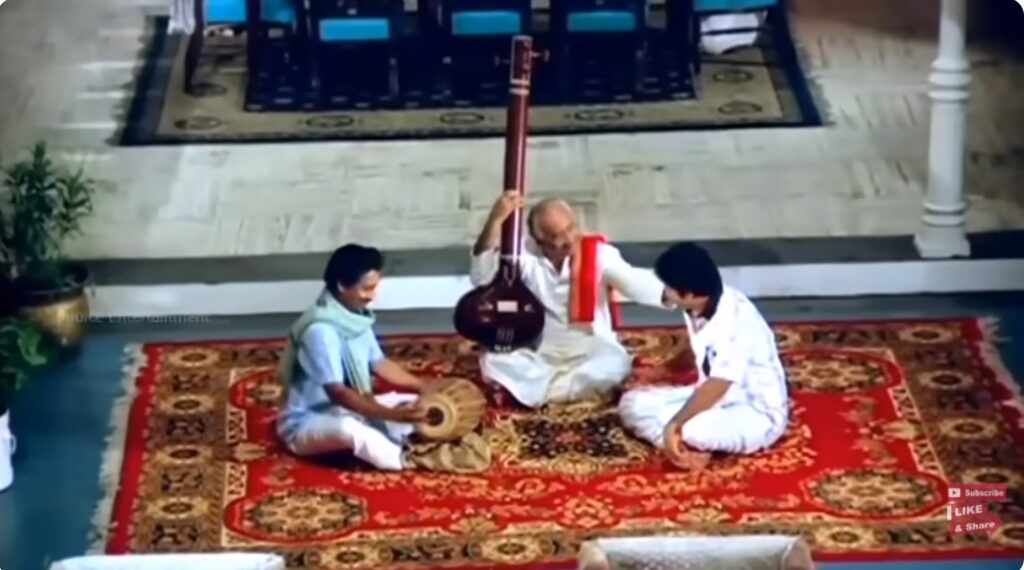
Several films involving Mohanlal also rely on this trope. In Chithram (1988), the lowly hired assassin Vishnu’s (Mohanlal) pure heart/interiority is revealed through his masterful rendition of the Carnatic keerthanam “Nagumo”. In Aaram Thampuran (1997), Jagannathan (Mohanlal), a rowdy, alcoholic and womaniser, is considered an unworthy inheritor of his tharavadu [ancestral home] until he breaks into a Carnatic-influenced, highly challenging song “Harimuraleeravam”. When only minutes before, he had been berated by the Savarna heroine, when the song ends, she folds her palms in almost reverent prayer to Jagannathan. In her book Themmadikalum Thamburakkanmarum (2011) [Rowdies and Lords], Jenny Rowena identifies two hero archetypes in Malayalam cinema, the rowdy themmadi (who is pitted against the aspirational ‘citizen’) and the feudal lord of the naalukettu, the thamburan. It is interesting to note that in Aaram Thampuran (among other films, including Raavanaprabhu (2001), Devasuram (1993), Narasimham (2002)), Mohanlal effectively combines the two, creating a composite rowdy-lord persona: rough yet mischievous, worldly-wise yet rooted, powerful yet tongue-in-cheek in his Savarna masculinity.
The use of playback singing and the ability to produce a composite of separate audio-visual aesthetics in Indian cinema furthers this tactic of Savarna appropriation. Amanda Weidman, in her seminal work Singing the Classical, Voicing the Modern (2006), maps out how the nationalist project ‘sanitised’ classical music by separating the body from dance and movements, which, she argues, was not an innocent separation but a move biased towards the subaltern performers whose art forms often mix dancing with singing. Yesudas’s voice and the tool of Carnatic legitimisation have been instrumental in creating this transcendental, Savarna interiority, while celebrating a rowdy visual exteriority that involved crime, womanising, alcohol, and drugs.
The subaltern woman also seeks redemption in the framework of Carnatic music (albeit rarely, since more traditional forms of redemption are offered either by marriage or simply being disposed of altogether). In Nandhanam (2002), the lower caste orphan Balamani (Navya Nair) is a live-in maid at the Ambalapaattil mansion. An ardent devotee of Guruvayoorappan, she is unable to visit the temple even after having lived in Guruvayoor for over a year, due to one mystical reason or the other. When she falls in love with Manu (Prithviraj), the Savarna NRI heir, she is admonished and unceremoniously kicked out of the household, despite being the primary caregiver for the family matriarch Unniamma. Just before leaving, Balamani breaks into a heartfelt rendition of “Kaarmukil Varnante”, a Carnatic-adjacent composition, sung by K. S. Chitra. At the end of the song, Unniamma is in tears and finally accepts Balamani as someone who may legitimately occupy the position of Manu’s wife.
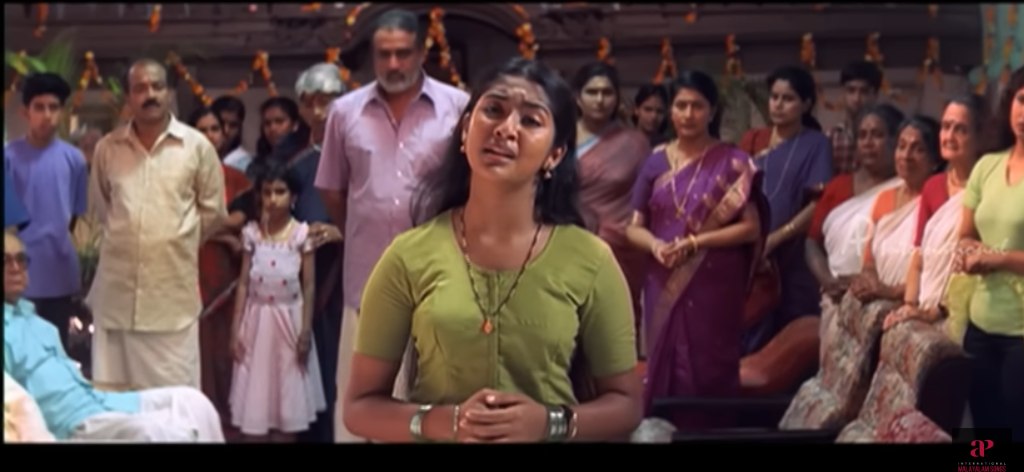
It is interesting to note that, much like in the case of Yesudas, Balamani never enters the Guruvayoor temple, even at the end of the film. She is instead granted a real vision of Lord Krishna—a metaphor for her rich interiority and devotion—but the social frameworks of the real world, however, do not provide access to her caste-marked body. It is no stretch to read that the string of “mystical” reasons that denied her access to the temple is a composite social framework of caste, class, and gender, but the fantasy of filmic imagination allows us to erase this corporeal reality by instead placing the story in the realm of inexplicable mysticism and devotion. God himself may visit Balamani, but Balamani may not enter God’s abode.
In Sallapam (1996), Radha (Manju Warrier), also a lower caste orphan, is a live-in maid at the Nair household. When she performs a musical number with Sasikumar or “Junior Yesudas” (Dileep) at the gaaanamela [music festival], she falls in love with him. Sasikumar wears all-white clothes (like Yesudas) and claims that he hails from a long lineage of Carnatic musicians, later studying music at the prestigious Chembai Music College. But when Sasikumar’s real identity is revealed—a lowly aashari, or carpenter—Radha, as well as the other townspeople, constantly humiliate and mock him, to the point that Sasikumar is in tears. Later, Sasikumar performs a Carnatic composition “Padha Smaranasugham” at the kovilakam [manor] at the insistence of his Brahmin music teacher. At the end of his performance, Radha falls in love with Sasikumar once again, as his Carnatic virtuosity reforms his caste identity. Radha begins to imagine the two of them in Sanskritised spaces such as temples and kovilakams, the lungi-clad aashari [carpenter] now reimagined in white mundu [a dhoti-like garment worn around the waist] and shirt, and her own self in traditional Bharatanatyam attire. This dream of Sanskritisation and social aspiration is open to both low-caste members: for Sasikumar through his mastery of Carnatic music, and for Radha by extension, through marriage.
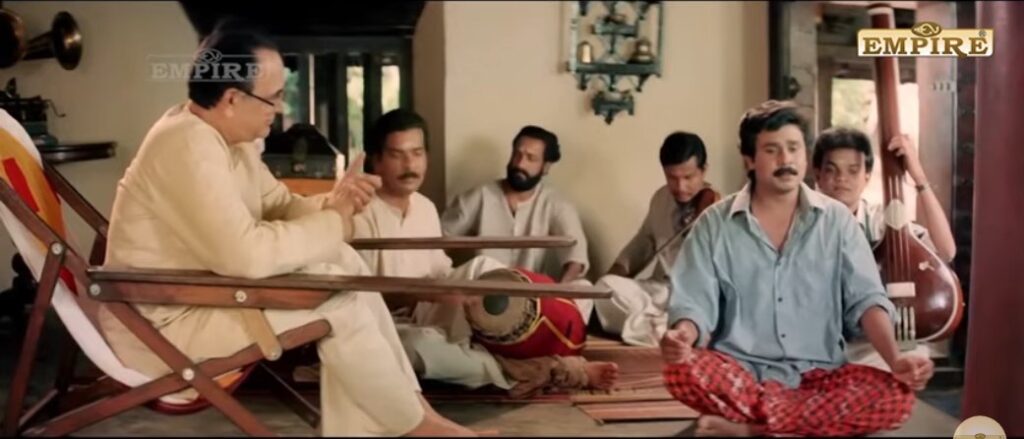
In recent Malayalam cinema, the Carnatic-adjacent semi-classical composition has been on the decline, the traditional “cinema of interruptions” (Gopalan 2002) having been forgone in favour of a narratively incorporated background score and minimal soundtrack. Films like Hridayam (2022) feature a Carnatic fusion-based soundscape to situate the film in a rooted yet modern world. Hridayam features Mohanlal’s son Pranav Mohanlal in the same Carnatic number “Nagumo”, achieving a seamless entry into his father’s Savarna industry positioning.
However, newer Malayalam films indicate a shift in traditional song and dance routines, focusing on a heavy background score with fewer songs. These songs (often not more than 2-3 per film) are often algorithm-friendly and easily reproducible in one-minute “hooks” with a reduced political and narrative weight. As a result, fewer songs engage with Carnatic music in new Malayalam cinema. However, the sanitising nature of Carnatic music remains a powerful tool of nostalgia for the modern Malayalam imagination, particularly in films like Varshangalkku Shesham (2024) that create a nostalgic and upper-caste dominant past using a particular aural soundscape. While the songs in Malayalam cinema may be changing, it is worth examining the new ways in which Carnatic music influences new film soundscapes both as a meaning-making tool and a nostalgic vehicle for a constructed, Savarna past.
The author extends credit to Dr Nakul Krishnamurthy, music scholar and performance artist, who is her frequent collaborator and whose research has been a helpful resource.
REFERENCES:
- Singing the Classical, Voicing the Modern, Amanda Weidman 2006.
- The Idea of Lata Mangeshkar: Hindu Sexuality, the Girl-Child, and Heterosexual Desire in the Time of the Five Year Plans, Passionate Modernity: Sexuality, Class and Consumption in India, Sanjay Srivastava 2007.
- “Themmadikalum Thampurakkanmarum: Malayalam Cinemayum Aanathangalum” (Rowdies and Lords: Malayalam Cinema and Masculinities), Jenny Rowena, Subject and Language Press: Kottayam, 2011.
- Cinema of Interruptions: Action Genres in Contemporary Indian Cinema, Lalitha Gopalan 2002.
FILMS:
- Dil Se (2002) dir. Mani Ratnam.
- His Highness Abdullah (1990) dir. Sibi Malayil
- Udayapuram Sulthan (1999) dir. Jose Thomas
- Prem Poojari (1999) dir. Hariharan
- Chithram (1988) dir. Priyadarshan
- Aaram Thampuran (1997) dir. Shaji Kailas
- Nandhanam (2002) dir. Ranjith
- Sallapam (1996) dir. Sundar Das
- Hridayam (2022) dir. Vineeth Sreenivasan
- Varshangalkku Shesham (2024) dir. Vineeth Sreenivasan
- Narasimham (2000) dir. Shaji Kailas
- Devasuram (1993) dir. I.V Sasi
About the Author: Namita Krishnamurthy is an actor and writer from Chennai, India. She graduated from IIT Madras with a Masters in English Studies. She is interested in the politics of the body, religion, and performance.Her fiction has been published or is forthcoming in Strange Horizons and Hammock India, and her research has appeared in Cambridge Scholars. She is currently working on her first novel.


