
With the onset of neoliberalism and the restructuring of direct tax laws in the 1980s aimed at simplifying tax systems and increasing revenue generation, broader shifts in cultural consumption and economic behaviour emerged in India. Simultaneously, the growing presence of “the camera” as a commodity in advertisements and films played a pivotal role in shaping middle-class aspirations and fostering a culture of both seeing and being seen through the camera. This transformation extended into Malayalam cinema, where the emerging cinematic ethos also introduced a distinct iteration of the modern Malayali hero. Often urban or urbanised through some exposure to the city, well-educated, and morally upright, he frequently carried a camera as a symbol of modernity (Appadurai 12) and engagement with the visual world around him.
The Early-scapes of Masculinity and Camera
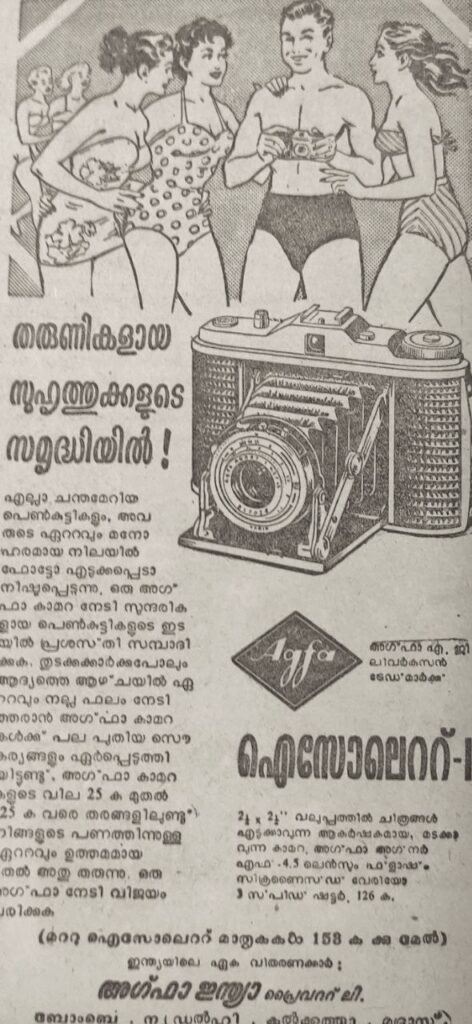
The man with a still camera has a curious history in Kerala, starting with Kodak’s “father-photographer”1 (Orpana). Shifting their advertising strategy to the New Indian Woman Photographer (CP) and to the Indian nuclear family post-independence, Kodak adopted this figure of the modern Indian “father-photographer” as a secondary yet pervasive trope in its print advertisements. Unlike the amateur enthusiast, this figure marked a departure from the open, outdoor, hyper-masculine portrayals commonly associated with competing camera brands, such as Agfa (see Fig. 1), which were prominently in circulation at the time. Such advertisements frequently positioned men with cameras within the domain of the public sphere, where the camera functioned as an extension of their masculine presence, drawing attention to them and heightening their sexual appeal. In the given Agfa camera advertisement, for instance, the male photographer becomes an object of female desire, not merely for his persona, but for his ability to photograph them.
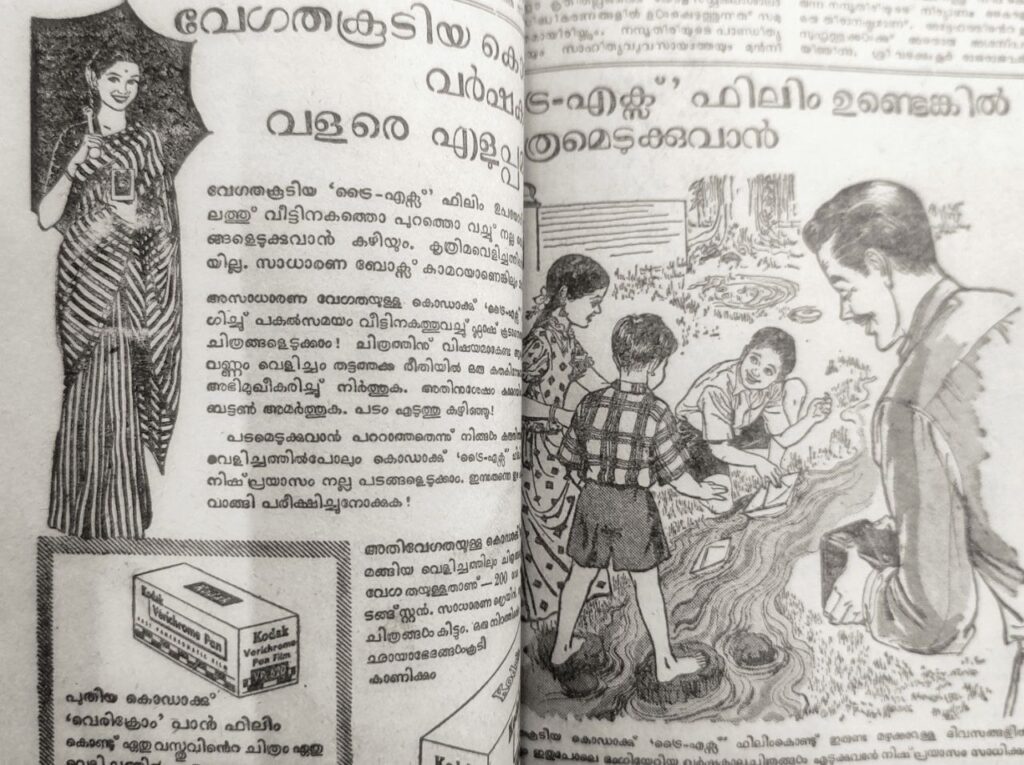
The “father-photographer”, in contrast, was often portrayed as a gentle, domestic presence indoors where he photographed his nuclear family. Outdoors, he captured the family vacation, especially of the children. Frequently shown holding the camera (see Fig. 2), he was depicted not as the subject but as the one preserving the family’s cherished memories, often positioned quietly in the background. This repositioning of the father figure, particularly in Kodak advertisements, mirrors a broader post-World War shift in British Kodak advertising, where the father moved from centre stage to a more subtle, supportive role.
The Modern Malayali Tragic Hero with a Still Camera
Fast forward to the golden age of Malayalam cinema, arguably spanning the 1980s and 1990s, and we witness a shift towards a new cinematic sensitivity. Deeply influenced by the New Wave cinema of the 1970s, this evolving sensibility also brought with it the figure of the modern hero, typically urban or having some exposure to “the city”, well-educated, morally upright, and sometimes seen carrying a camera as an emblem of modernity. This figure embodied a subtler form of masculinity, distinct from the emerging action hero archetype, which was heavily dependent on superstar charisma and formulaic narratives that would come to dominate the commercial cinema of the 1990s. This nuanced, “subordinated masculinity” (Connell and Messerschmidt 832), “the man with the still camera”, lingered in a handful of Malayalam films around the turn of the century, where echoes of this modern hero continued to appear in similarly sensitised, character-driven narratives.
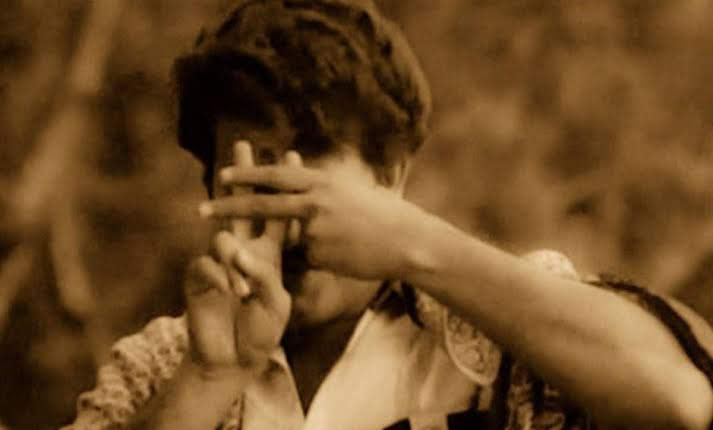
The first, probably distinct image of a photographer hero in Malayalam cinema is that of the veteran actor Mohanlal’s Vishnu in the 1988 Priyadarsan film Chithram (The Picture). A screwball comedy that premiered over the Christmas weekend in 1988, Chitram generated 3.5 crores at the box office, making it the most commercially successful Malayalam film of its time (Ahmad). The film is characterised by a highly noticeable gesture performed by Vishnu, as he intertwines his fingers to mimic the movement of a camera shutter, particularly when interacting romantically with his co-star Kalyani, played by the actor Ranjini. Vishnu’s backstory is depicted in flashbacks, revealing that he worked as a freelance photographer and was married to Revathy (played by Lissy), a mute dancer.
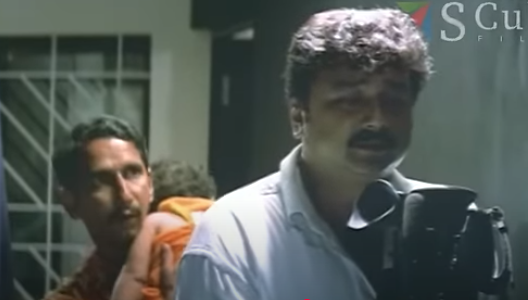
Similarly, Kochu Kochu Santhoshangal (Small Joys), a 2000 film directed by Sathyan Anthikkad, which won the National Film Award for the best feature film in Malayalam, has Jayaram playing Gopan, a single father employed at a gas pump who occasionally works as a photographer. The flashback once again portrays a youthful and naive Gopan, working as a studio photographer, who falls in love with Asha (Lakshmi Gopalaswamy), a dancer who hails from an affluent family.
What sets these films apart is their portrayal of the photographer and the camera not as villainous or merely evidentiary devices (Harikrishnan), but as heroes driving the central narrative. The protagonists in these films are photographers by profession, and their relationship with the camera is not incidental; it is deeply personal and intricately woven into their lives. The camera functions not just as a tool, but as an extension of the self, playing an active and transformative role in the unfolding of the narrative. The protagonists in Chithram and Kochu Kochu Santhoshangal encounter their love interests through their profession as photographers and through the act of seeing mediated by the camera. This constitutes a crucial event in each of their lives, and the subsequent progression of the storyline is centred on this pivotal moment of encounter.
Additionally, in contrast to earlier representations of the “Agfa photographer” on film, such as in Boeing Boeing (dir. Priyadarshan, 1985), where Mohanlal’s character Shyam and Mukesh’s character Anil are depicted as photographers and womanisers who use the camera and their photographic skills largely for deception and malice, this particular set of films introduces photographer-protagonists as civil and morally conscious figures. Unlike in Boeing Boeing, where photography is celebrated as an extension of youthful masculinity, playfulness, and sexual adventurism, these latter characters are situated within realistic social conflicts that complicate their subjectivity. They are not elevated as successful or glamorous photographers by the end of the narrative; rather, their trajectories are marked by transformation, with the camera ceasing to signify hedonism and instead becoming part of a process of ethical and personal change.
More intriguingly, the photographer, here, emerges as a tragic hero, whose hamartia (tragic flaw)2 is intimately tied to the pressures of “hegemonic masculinity” (Connell and Messerschmidt 829). In both Kochu Kochu Santhoshangal and Chithram, the male protagonist’s actions are driven by a patriarchal anxiety, manifested in the former as jealousy over the wife’s professional success and perceived neglect of domestic duties, and in the latter, as a misguided suspicion of infidelity, which results in him accidentally killing his wife. These narratives progress with the tragic fallout of the initially patriarchal heroes, wherein their masculine insecurities lead to (mostly) irreversible consequences. Yet, in both films, this dominant masculinity eventually gives way to a form of subordinated masculinity: the gentle, family-oriented hero—still the boss, still loved—but now rependent and transformed. Both protagonists are reconfigured as ideal family men, embodying the “father-photographer” figure.
In Chithram, Mohanlal’s character absconds from jail to seek money for his child’s surgery, and his photographer persona recedes into the background. He becomes the entertainer, the problem solver, the all-loving man whose photographic impulse is reduced to a fleeting finger gesture mimicking a camera. Similarly, in Kochu Kochu Santhoshangal, Jayaram’s character is seen working at a petrol pump while taking care of his young son. His once-flourishing photo studio is forgotten, and by the end of the film, he watches his reunited wife dancing, not through a lens, but with his bare eyes. In both films, the camera-wielding, mobile man is ultimately replaced by the stable, domestic father figure, signalling not the erasure of the “Agfa photographer” but the emergence of the “father-photographer” as a recurring heroic trope. Therefore, while the former continued to exist, it was the latter who came to be regarded as more consistent with Malayali constructions of heroic masculinity.
The Camera as an Agent
Towards the end of the 1990s, a similar second trope of the “photographer-hero” emerges in two films, Chandranudikkunna Dikkil (dir. Lal Jose, 1999) and Mazhavillu (dir. Dinesh Saboo, 1999) where the camera, closely associated with the male protagonists, becomes a potent marker of modernity. Here, the heroes, urban in origin and sensibility, are educated, rational, and energetic young men. Although not photographers by profession, the camera stands as a signifier not only of their modern outlook but also of their vulnerability and naivety. For instance, the initial conflict between Madhavan (Dileep) and Radha (Kavya Madhavan), the protagonists in Chandranudikkunna Dikkil, centres around the camera, which gets resolved as their romantic relationship develops. Similarly, the camera is a loyal companion to Mahesh (Kunchacko Boban) in Mazhavillu that even exposes his murder. The city man, once a symbol of progress, optimism, and modernity, is ultimately drawn into a “regressive” trajectory: from a bank officer to a taxi driver in the former, and meeting his death in the latter. The camera, once a marker of his buoyant character, also becomes implicated in these realist narratives, as the hero gradually comes to recognise that the world around him may not be as untainted as he once believed, thereby caught up in a chain of irrevocable events.
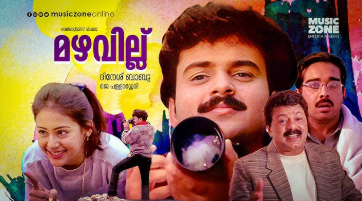
Here, the modern hero is not the triumphant “prosthetic God” (Wood and Freud, 44). Rather than extending his capacities, technology, embodied in the form of the camera, becomes bound up with modernity’s contradictions and is ultimately implicated in his downfall. The “photographer-hero,” shown as a perceptive observer, fails precisely because his technological gaze does not translate into critical insight. His photographic vision renders him adept at capturing images but blind to the underlying realities and tensions surrounding him. Unlike the hypermasculine, victorious figures of Aaraam Thampuran (1997), Narasimham (2000), and Valliettan (2000), who overcome adversaries through physical prowess and moral clarity, these camera-wielding protagonists are ultimately undone—recast into roles of subordinated masculinity or erased into obscurity. Their transformation reflects a broader critique of modernity’s promises, exposing the fragility of technologically mediated masculinity within entrenched patriarchal structures. The Malayali “photographer-hero”, ultimately, is the fallen man who gets crystallised by the turn of the century.
Works Cited
- Ahmad, Safeer. “‘Chithram’ Enna Boxoffice vismayathinu 31 Vayassu.” Manorama Online: Breaking News, 23 Dec. 2019, www.manoramaonline.com/movies/features/2019/12/23/chitram-movie-31-years-special-story.html.
- Appadurai, Arjun. Modernity at Large Cultural Dimensions of Globalization. University of Minnesota Press, 2010.
- Aristotle. “Poetics.” Edited by Penelope Murray and T.S. Dorsch, Classical Literary Criticism, Penguin, 2001.
- Connell, R. W., and James W. Messerschmidt. “Hegemonic Masculinity: Rethinking the Concept.” Gender & Society, vol. 19, no. 6, Dec. 2005, pp. 829–859. SAGE Publications, https://doi.org/10.1177/0891243205278639.
- C P, Greeshma. “The Indian Kodak Girl’s Domestic Turn.” The MAP Academy Blog, 15 July 2025.
- Harikrishnan, S. “Between Fact and Fiction: Couple-Photographs in Malayalam Cinema.” Issue, no. 32, 30 Apr. 2021, Ala.
- Orpana, Jennifer. “Finding Family in The Times of India’s Mid-Century Kodak Ads.” Trans Asia Photography, vol. 9, no. 1, Fall 2018. Family Photographs, guest edited by Deepali Dewan, http://hdl.handle.net/2027/spo.7977573.0009.107.
- Sontag, Susan. On Photography. Penguin, 2008.
- Sanjay Srivastava. “Masculinity studies and feminism: Othering the self, engaging theory.” Men and Feminism in India, pp. 35-49. Routledge India, 2018.
- Wood, Sarah, and Sigmund Freud. Civilisation and Its Malcontents. Ma Bibliothèque, 2017.
About the author: Greeshma C P is Guest Faculty at the Centre for Comparative Literature, University of Hyderabad. Her doctoral research explores intersections of visual culture, modernity, and twentieth-century Kerala.


