
Saranya Narayanan examines how Don Palathara’s Family (2023) unmasks the unsettling truth lurking behind social respectability, and uses the predator-prey metaphor to expose the true danger—human, not animal—that hides in plain sight.
Saranya Narayanan
It was quite an insight to me when I realised that a film which would haunt me for days, was not from a typical horror genre. I decided to watch Family, the 2023 film directed by Don Palathara, with the assumption that it would be yet another overwrought film discussing the bonds of a close-knit family, and at most, a film dealing with the challenges of the protagonist in keeping the family together. However, the opening scene already proved otherwise; Sony, the character played by Vinay Fort, takes his nephew Subi back home after a night stay. This scene presents itself as a gesture of familial care and affection when he warns the child of the leopard attacks in the neighbourhood. In a stark contrast, the boy is shown standing alone in the bathroom, calm but withdrawn, examining his body, which implies a troubling experience. Sony, who hails from a rural part of Kerala, is painted as an “ideal man”; a favourite of his family elders and people of the village, and liked and respected by everyone. But the guise of a ‘caring’ elder brother or a ‘tutor’ is a mere façade to camouflage his offences against the children of his family.
Another striking element that caught my attention was the representation of the concept of predator as portrayed in the film; it exhibits the striking contrast between what appears and what is perceived as reality- the leopard that prowls in search of prey, and Sony, amidst a crowd, undaunted by the eyes watching him, lurks around children. This fearlessness evokes the words from Mary Shelley’s Frankenstein, “Beware; for I am fearless, and therefore powerful” (168), although the creature’s fearlessness is a consequence of his suffering. Sony’s power emerges from his social standing and acceptance.
The Predator-Prey Divide
Since early times, philosophical inquiry like Aristotle’s scala naturae or the ladder of nature, established an ontological order placing humans above animals because of the former’s reasoning skills. The later theorists further reinforced this notion of humans as the privileged centre; René Descartes proposed the automata, arguing about the lack of consciousness, emotion, pain or even a soul, thus morally denying existence and acceptance of animals as living beings, “there is none at all that puts weak minds at a greater distance from the straight path of virtue than to imagine that the soul of beasts is of the same nature as ours” (33). He considers it a moral decay to assume the presence of soul in an animal as it diminishes human status to that of “ flies and ants” (33). Furthermore, religious doctrines and even modern scientific studies legitimised this ordering, further enabling humans to objectify, dissect and study animals as ‘specimens’.
In the modern age, Posthumanism and Human-Animal studies have challenged these traditional anthropocentric notions, critiquing the human-created hierarchies that elevate them above animals. Theorists and thinkers from both discourses have considered the human-animal dichotomy as more of a measure to establish human dominance rather than a biological divide.
Jacques Derrida’s The Animal That Therefore I Am (2002) deconstructs the mainstreaming of human existence over other species and criticises the Western philosophical notions of Kant, Heidegger, Lacan, and Levinas for their definitions of being human in contrast to the biological features of an animal. Providing an unsettling example of his cat confronting his naked body, he states how “Nudity gets stripped to bare necessity only in that frontal exhibition, in that face-to-face” (11). This instils a sense of deep shame in him, a Levinasian nakedness, where, in an encounter with the other, there is an immediate moral responsibility called for. Derrida expands this notion and considers the possibility of an animal being the other and how it might ‘look’ back. In the gaze of the cat, Derrida is reminded of his self and his vulnerability. This encounter blurs the boundaries for distinction sketched by the traditional philosophers and thinkers.
The predator-prey categorisation (another framework which reinforces anthropocentrism) was further backed by the evolutionary theories and thus established a clear dichotomy between likeable species and apex predators that need to be hunted down. Over the years, humans have proved to be a threat to other species, with their acts of hunting and poaching, thus driving the wild animal population to near extinction. The human tendency to overpower and tame the non-human is established through this categorisation of the violent and the weak. Don Palathara’s Family illustrates this dichotomy through the image of the leopard, which is perceived as the “real threat” and therefore to be eliminated, while Sony moves freely, embodying the role of the familiar.
Who is the Predator?
The predator-prey divide, when discussing the film, reflects on the long argued notions by Animal Studies theorists of how biological determinism in distinguishing animals from humans is deeply flawed. The narrative subtly foregrounds this through the scenes where Sony’s friends talk about the immobilising fear upon encountering the ferocious leopard and when a young girl finds her pet dog attacked; these incidents are an expression of the biological role of the leopard as a wild animal rather than a moral failing. The leopard, after all, hunts only when hunger stirs. However, Sony’s predatory behaviour delineates how social standing and power mask reality. His manipulative and controlling nature ensures his safety; Subi, the child he exploits, admires him for the attention he gives, unable to identify the harm he is enduring. Sony assures that his presence is that of a protector to the children he encounters. Looking back at the very first dialogue spoken by Sony, “It won’t hurt you unless it feels threatened”, referring to the leopard, is both ironic and a foreshadowing of the events that unravel in the film. This distinction between the predator and prey is unwittingly a description of himself rather than the leopard. There are subtle glimpses that hint towards a troubled relationship between the brothers, Sony and Nobi. In one instance, when Sony attempts to initiate a conversation, Nobi responds with disinterest. Even when Sony offers to teach him to drive, he shows discomfort in such conversations. This, coupled with the visible fear of seeing his brother conversing with his friend are indications of an underlying trauma. These psychological rifts compel one to think of the possibility of abuse Nobi himself must have endured from his brother. Even when Rani (character played by Divya Prabha) raises doubts regarding Sony’s behaviour and confides her suspicions to her aunt, the narrative soon changes, and she is condemned for drifting away from the spiritual path.
There were two particular scenes that compelled me to look at the film from a predator-prey divide. The first is when Sony, while at a house of mourning, notices the presence of Stephy’s family. He finds this a perfect opportunity to meet the young girl he tutors and grooms under the guise of affection, alone at home. The scene that follows is agonising and elevates the horror; Sony arrives at the house, and when nobody answers the door, peers through the window while the child hides, avoiding confrontation from her predator. In contrast to this, another scene shows two children playing near a river, confronting the leopard. The child is paralysed by fear, while the leopard remains indifferent to their presence and walks away, posing no threat. The contrast presented was alarming. The film ends with Sony being appointed as a teacher in a school, where he watched the students, assessing his new hunting ground.
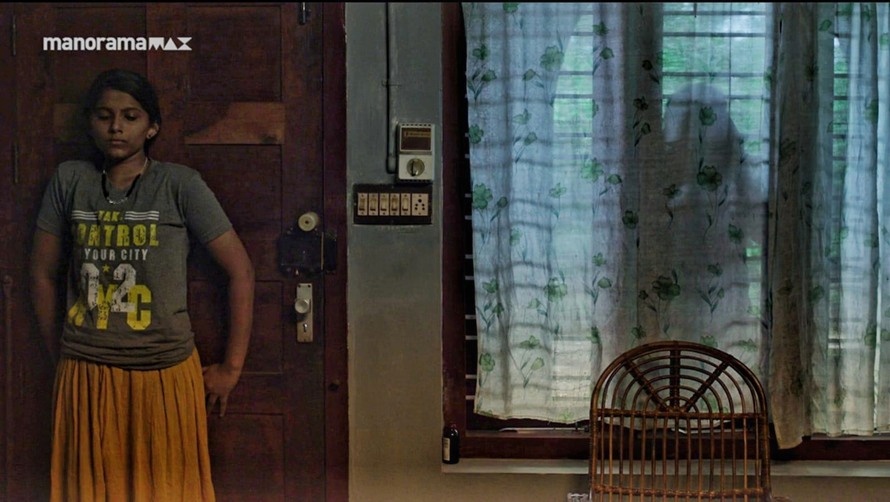
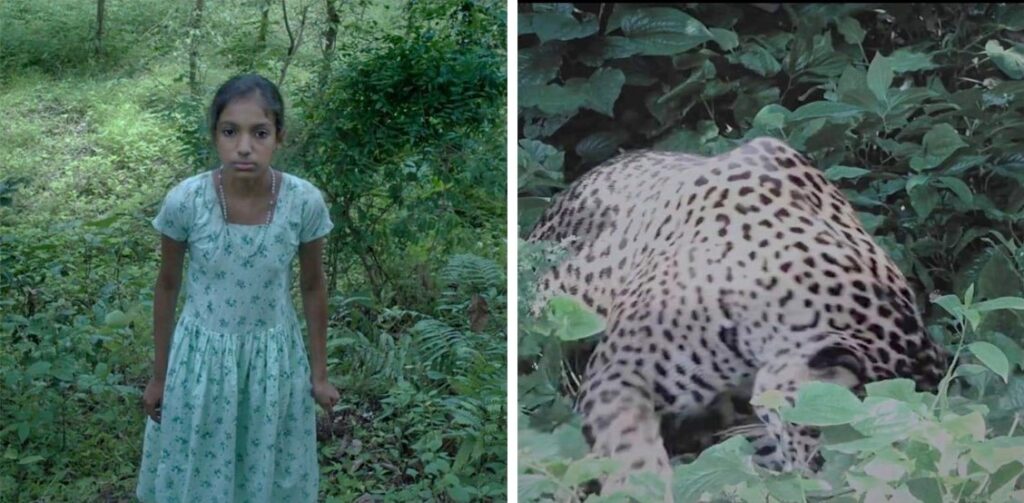
This contract, presented throughout the film, questions the definitions and discussions surrounding animals and humans. The anthropocentric worldview emphasises on reducing non-human species to their utility and eliminating wild species under the claims of biological threats and vicious appearance. The use of animal image in the movie has aided in conceptualising the concerns discussed earlier in relation to the predator-prey dichotomy. The leopard is a decoy hiding the presence of the true predator amongst them. The society’s fixated fear of the leopard is a reflection of how people perceive the wild when the real threat lingers amongst them. The motifs in the film speak loudly of the veiled violence in family structures and challenge what one perceives as an understanding of animality and the human-animal divide.
References:
- Descartes, René (1998). Discourse on Methods and Meditations on First Philosophy (trans. Donald A. Cress), Indianapolis: Hackett Publishing Company, pp. 33.
- Derrida, Jacques (2008). The Animal That Therefore I Am (ed. Marie-Luise Mallet), New York: Fordham University Press, pp. 11.
- Palathara, Don. (Director). (2003). Family [Film]. Newton Cinema
- Shelley, M. (2015). Frankenstein; or, The modern Prometheus. Penguin Books India.
About the author: Dr. Saranya Narayanan is currently an Assistant Professor at the Department of English, School of Humanities and Social Sciences, Kristu Jayanti (Deemed to be University), Bengaluru, Karnataka, India. Her research interests include Trauma and Memory Studies, Gender and Women’s Studies, and Animal Studies.


Excellent article!