
Ahnas offers a visual and experiential entry into the spectacular festival of Irupathettaam Onam of Ochira. At a moment when dislocated histories and reinterpreted myths are increasingly mobilized for divisive political ends, the article finds value in staying with the ‘feeling’ of belongingness and participation that a festival can generate and an art can nurture.
Ahnas Muhammed
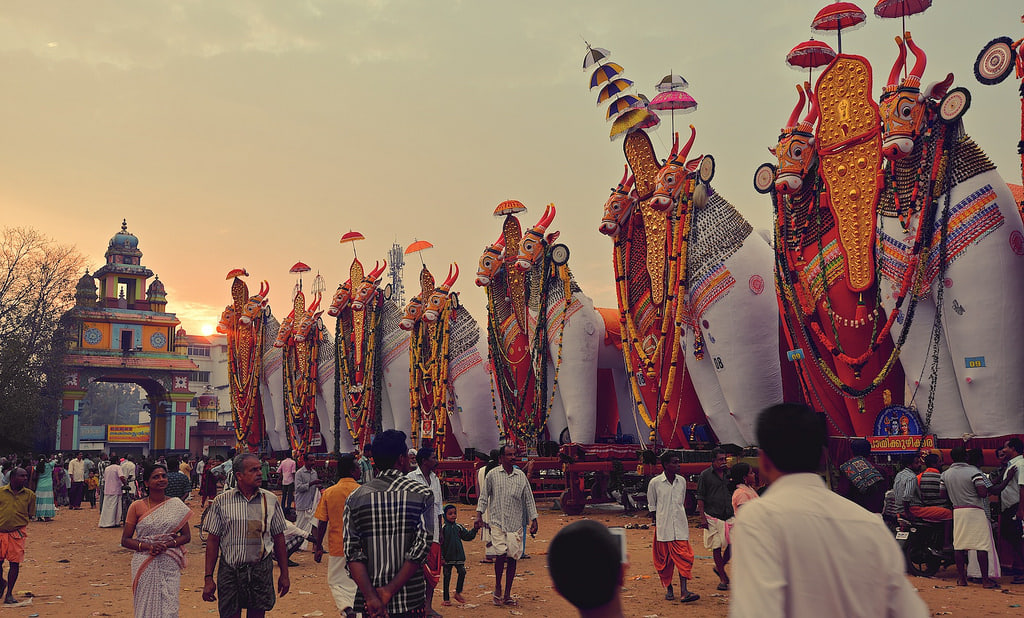 Kettu kazcha at Oachira Parabrahma Temple, Wikimedia Commons, 2016.
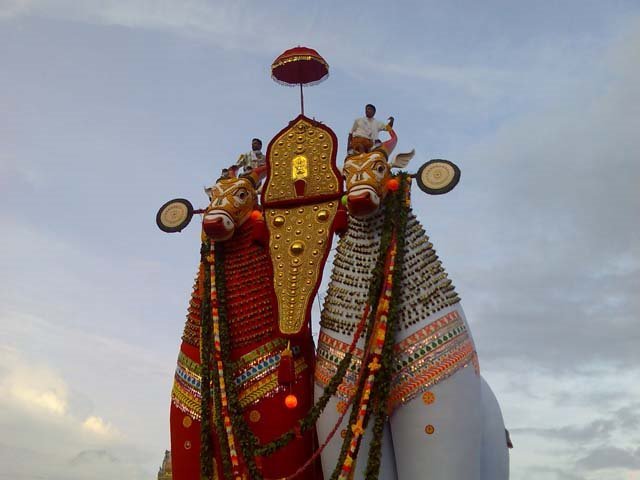
As the monsoon settles down and the joys of harvest fill hearts and palettes, the Onattukara1 region of Kerala gathers in a spectacle that turns earth and hay, bamboo and wood, into a divine portrait of art. Irupathiyettam Onam (The 28th Onam), a spectacular festival that is at once devotional, communal, political, and deeply artistic, occurs in the town of Ochira twenty-eight days after the harvest festival of Onam. At its heart stands colossal bull effigies, known as Kettu Kaala, made from bamboo frames packed with hay and other post-harvest materials. Rising in pairs, these bull figures stand in all their glory across the temple fields of Ochira, home to the Parabrahma temple, believed to be the Universal Unconscious in the ‘Hindu’ cosmology. Irupathiyettam Onam brings together communities historically rooted in agriculture as they offer gratitude to Parabrahma for the annual harvest and honour the cattle that were integral to their labour. It is a collective gesture of gratitude that binds religious belief, work, and land into a single ritualistic expression.
The making of the bull effigies is an act of collective creation. It is a process that extends throughout the year, right from the end of one year’s festival until the next. Artisans and craftsmen turn their everyday tools into instruments of sacred craft.2 Each effigy represents a kara, a local territorial unit. Fifty-two karas from the wider Onattukara region bring their creations to the temple grounds for the festival (The Hindu, 2018). These karas fall under what are now the Karunagappally and Mavelikkara taluks. In some years, more than two hundred pairs of bulls are brought and arranged across the field, each one distinct in its choice of colour, cloth, and metal, and each bearing the pride and identity of its makers. There are also cash prizes awarded by the karasamithi for the best bull effigy, even though these amounts are negligible compared to the actual cost of constructing the bulls, which often runs into tens of lakhs, as Kuttan sir, my interlocutor, remarked. He elaborated how each kara raises its own funds through community contributions, but a significant portion comes from sponsorships, usually from large-scale businessmen who donate both for the blessings of the deity and as a gesture of philanthropy. The entire scene, Kettukazhcha, draws nearly five lakh people, transforming Ochira into a vast open-air museum of rural imagination, second only to Thrissur Pooram (Mahesh, 2025).
My interlocutor, Kuttan sir, who is a local school teacher and a pious devotee of Parabrahma, elaborates on the philosophy and divinity of the temple:
“It is a spiritual abode without a physically built traditional temple structure, but only a prathishta (consecrated presence). All gods are embodied in Parabrahma; there is no need to visit multiple shrines when all blessings reside here. And since Shiva is the Mahadeva (the supreme God), the prathishta is commonly understood by the people as Shiva” (author’s translation, original in Malayalam).
The bull effigies are therefore also associated with the sacred bull Nandi, believed to be the vehicle of Lord Shiva. When I further enquired whether there were any other reasons for the effigies to take the form of bulls, Kuttan sir narrated a story of Akavoor Chathan from the Parayi Petta Panthirukulam (The Twelve Clans Born of a Paraya Woman) folklore. As one version of the story goes, Akavoor Chathan was one of the twelve children born to Parayi3 (a woman of the Paraya caste) and Vararuchi (a scholar and a minister of King Vikramaditya’s court). Abandoned at birth, he was later found and taken in by Achan Namboothiripad, the patriarch of Akavoor Mana, in whose household he grew up as a servant. It was during his service there that Chathan once asked the Namboothiri what Parabrahma looked like. The Brahmin mockingly said that Parabrahma resembled a maadan poth — a fierce, untamed bull. This image, however, remained with Chathan as the two journeyed south on a pilgrimage. While crossing a dense forest, they unfortunately get separated from one another. The Brahmin, upon realising that Chathan was no longer with him, began retracing his steps in the hope of finding him on the way. Much to his surprise, he found Chathan deep in prayer before a bull. It is said that as the Brahmin dismissed Chathan’s act of devotion as foolishness, Parabrahma himself appeared and affirmed that the bull was indeed his manifestation (Sankunni, 2025). The divine bull and Chathan are said to have remained in the same spot, where the Parabrahma pratishta stands today in Ochira.
While the folktale narrates a story of belief and devotion, there is a parallel historical narrative that situates the festival as a marker of a community’s resistance against political power. Oral narratives from the region recount how the festival took on an additional order of significance after the conquest of the Kayamkulam (Odanad) kingdom by Marthanda Varma, the ruler of Travancore, in the late eighteenth century (Menon 247, 2007). Kuttan sir remembers stories he has heard as a child about the Onattukara region, once part of the Kayamkulam kingdom, being assimilated into the expanding dominion of Tiruvidancoor (Travancore). In the aftermath of this loss of political sovereignty, communities began to articulate memory and identity through artistic and commemorative practices, most notably what later came to be known as Ochira Kali.4 Observed in the month of Mithunam, Ochira Kali is a ritualised martial reenactment performed in knee-deep water in paddy fields, where participants simulate combat using wooden weapons, invoking memories of violence, defeat, and dispossession following the Travancore conquest. It is through this embodied and confrontational register that Ochira Kali engages with the history of conquest. Yet this historical memory does not remain confined to Ochira Kali alone. Stories of loss, resistance, and regional pride circulate across performances and narratives, finding expression in Irupathiyettam Onam as well, even though the two festivals are observed in different months. Rather than operating as discrete forms, Ochira Kali and Irupathiyettam Onam co-constitute and amplify one another as commemorative practices through which political history is reworked into celebrations of geographical belonging. It is within this shared field of remembrance that the Kettukazhcha (loosely translated as a public display) becomes a key site for the performance of this identity, materialising what Kuttan Sir refers to as the “Kayamkulam desakkar” (the people of Kayamkulam). What is noteworthy here is how such traditions are transmitted across generations through overlapping stories and embodied practices, retroactively producing a sense of belonging that is not merely remembered but enacted.
What makes this festival particularly remarkable for me is not merely its scale but also a sense of belonging that it engenders. And I do not mean this in the sense of a romanticised syncretism that scholars are often quick to celebrate. Speaking as a Muslim from Onattukara, shaped by the same soil, stories, and sensibilities that embody it, the festival has never appeared to me as a strictly ‘Hindu’ event. It has always ‘felt’ more like a matter of place(s) than of faith, of belonging rather than religion—a collective sport drawn together by a competition around which kara would win, how the Kaalabhairavan would look, and whose bull would outshine the rest. The spirit of celebration and competition has been geographic as much as it is religious. And in today’s day and age, wherein shared lives are constantly pulled apart, this ‘feeling’ holds a potent political value. And it is for this reason that these (hi)stories demand to be narrated, documented, and made visible beyond the confines of local memory.
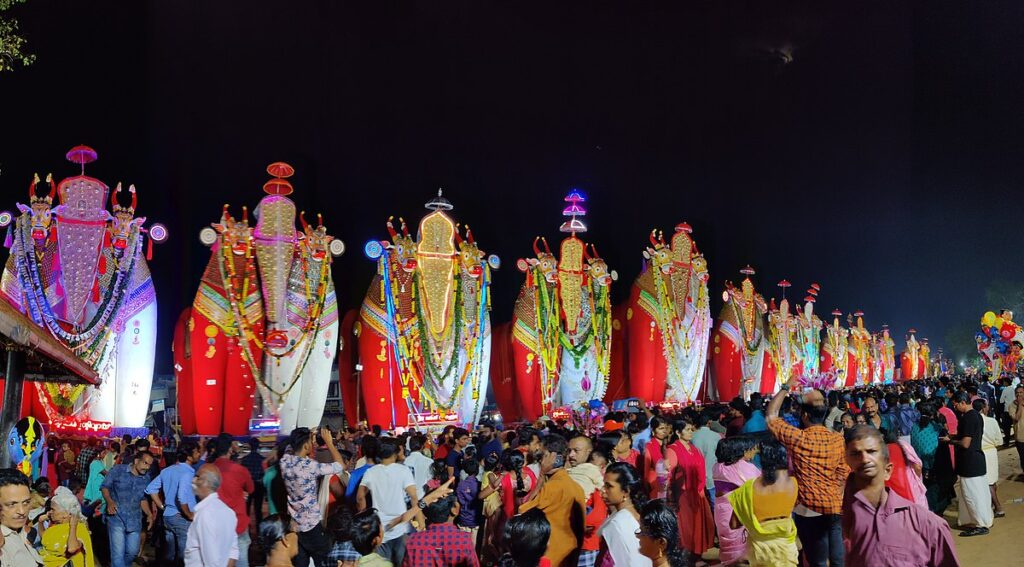
This layering of devotion and defiance makes the Ochira festival a deeply political and aesthetic form. The defiance at work here is neither overt nor programmatic; it unfolds through narrative and ritual gesture. In the story of Chaathan, it appears in the refusal to accept that a bull cannot embody the Parabrahma—a hesitation that troubles settled distinctions between form and formlessness, image and divinity. In another register, it surfaces in the historical memory of Marthanda Varma’s conquest, after which the festival appears to have taken root with greater intensity, expanding into Ochira Kali and drawing the community into heightened participation. What could no longer be articulated through political authority found expression through art and rituals, where memory survived not as records but as practice.
While its surface shimmers with celebration, its substance carries the pulse of resistance. The people of Onattukara do not simply remember their past; they re-enact it annually through art. Each effigy symbolises their gratitude to the lord Parabrahma in iconic form, indexing the larger socio-political identities and the particularities of cultural pride. It is in this interplay that the festival achieves its peculiar power: it transforms art into an iconic (relating to icons/images/qualities) political language that requires no speech. And I hope it remains so, though I am unsure how confidently one can expect this continuity within the contemporary political landscape. As it stands, documenting it becomes essential to testify that there was a time when it was indeed thus.
References:
- CR Mahesh [@crmaheshmla]. (2025, September 19). [Video reel]. Instagram. https://www.instagram.com/reel/DOyPiy4AQmC/?igsh=MTJudTBlcTlrY3NqdQ==
- Kottarathil Sankunni. (2025). Aithihyamala (18th ed.). DC Books.
- Menon, A. S. (2007). A survey of Kerala history. DC Books.
- Kerala Tourism. (2018). Oachira Kalakettu. https://www.keralatourism.org/kerala-article/2018/ochira-kalakettu/842
- The Hindu. (2019, October 8). Thousands witness car festival with biggest bull effigies in Asia. https://www.thehindu.com/news/national/kerala/thousands-witness-car-festival-with-biggest-bull-effigies-in-asia/article29621308.ece
- Personal interviews and oral histories conducted by the author. (2024–2025). Onattukara region, Kerala.
About the Author: Ahnas Muhammed is an independent researcher and currently a Young India Fellow at Ashoka University. He completed his Master’s degree in Society and Culture at IIT Gandhinagar and holds a B.A. (Hons.) in English from Hindu College, University of Delhi. His research brings psychoanalysis into conversation with anthropology to explore questions of populism, affect, and subjectivities in contemporary India.


