
B. Abhijith traces how recent Malayalam cinema reconfigures the family beyond generational hierarchies, turning it into a site of negotiation within a changing social world. Through films like Kumbalangi Nights, Falimy, and Pranaya Vilasam, he shows how shifting parenthood, individuality, and digital self-expression shape new middle-class affective collectives.
B. Abhijith
In a notable narrative development in recent Malayalam cinema, the family is freed from generational scaffolding and is featured as a question of how to relate to one another in a transformed social landscape. One earlier signal of this process was the disappearance of mother figures from narratives that feature family spaces. Bangalore Days (dir. Anjali Menon, 2014) mocks the idealized mother figure of earlier cinema through its self-indulgent mother character, while Maheshinte Prathikaaram (dir. Dileesh Pothan, 2016) depicts a home devoid of maternal presence. In Kumbalangi Nights (dir. Madhu C. Narayanan, 2019), four brothers living in disarray seek out their estranged mother, hoping her temporary return will restore their social respectability. In the new Malayalam cinema, the motherhood function is displaced from the sacrificial mother figure, and new cinemas demonstrate that “single fathers, loyal friends, elder siblings, or brothers can effectively take on the role of the mother” (Anu Paul, 2024). Along with unsettling the existing representations of family space, the new cinema has also introduced alternative visions of family, as in Kumbalangi Nights.
All of these pointed to the breakdown of the melodramatic centrality afforded to the middle-class family in Malayalam cinema. This breakdown has given rise to multiple responses that reimagine the family space in cinema. In one such prominent reimagination, the “family”, initially a trivial part of everyday life, gradually emerges to the centre of the narrative as an index of new subjectivity in the midst of social change. A few observations on how technologies of self-expression and the increasingly individualistic understanding of the body have reshaped interpersonal relationships in our midst are necessary before we can appreciate this representational shift in cinema.
Digital Media and the Subjective Recentering of Interpersonal Relationships
Until recently, it was very common in our social life to come across the image of a son who keeps a certain distance from his father once he reaches his adolescence, reflecting the weight of the father’s social role, and, sometimes, seen as the son’s way of announcing his arrival as an adult in the social world. The father is expected to uphold family authority and guide it toward middle-class respectability, while the son bears the burden of these expectations and often fails to meet them. A striking cinematic equivalent of this unease between the father and son is the father-son relation played out on screen memorably by Tilakan and Mohanlal in films like Kireedam (1989), Spadikam (1995) and Narasimham (2000). A running thread in these movies is the dramatic tension derived from the son’s struggle to depart from the comfort of maternal bliss and prove himself to his father. However, it is not easy to represent this father-son complex with the same intensity in today’s transformed social milieu.


An earlier example of this impossibility is the father-son relationship depicted in Maheshinte Prathikaaram. The film, in fact, makes explicit references to the movie Kireedam (dir. Sibi Malayil, 1989), not intending to establish a parallel, but to highlight a contrast with those earlier narratives, signalling the opening up of the family’s enclosed space to the social energies of the present. Though there is some resonance in the plot – the hero’s life changes dramatically after an unexpected encounter with strangers on the street – this tribute also serves as a negation of Kireedam’s emotional world. When Mahesh’s friend Crispin asks him whether he wants to end up like Mohanlal in Kireedam, it becomes the film’s own commentary on the contemporary world, where a new comic energy has released narratives from the tragic weight of the past.
It is as if a new lease of lightness has been breathed into the conventional mould of relationships with the emergence of social media in people’s lives and the widespread desire for self-expression, among other things. This process has brought about significant changes at the level of the representation of the everyday. The way in which celebrations like birthdays and wedding anniversaries have become an essential part of everyday life is an indication of this process. In an earlier phase, birthday celebrations were largely seen as the preserve of the upper-middle classes or aristocratic elites, who alone were considered capable of framing the fact of their birth as a ‘special event’ worthy of celebration. Today, however, the widespread commodification of labour power has disrupted this aristocratic exclusivity, turning individuals into owners of their own bodies and placing the biographical self at the centre of social life. The same holds true for wedding anniversaries. One can imagine a middle-aged couple who may have gone through most of their lives without ever taking a photo together or publicly referring to themselves as a couple, now posting a picture on Facebook on their wedding anniversary and calling themselves a couple – perhaps for the first time.
The unprecedented circulation of images in everyday life has created a situation in which unexpected aspects of one’s personal life have begun to take on a representational dimension, echoing Guy Debord’s characterization of commodification as the process by which everything that was directly lived has moved away into representation. It is also indicative of a subjective transformation that endows the relationships that you have taken for granted your whole life with a new reflexivity. It is as if you were looking at the same people whom you have lived with all your life through new eyes, and, figuratively speaking, calling them by their names for the first time. A long-entrenched culture of deference has been loosened by the spread of consumer culture in our everyday lives. This involves a subjective recentring by which the formation of individual subjectivity simultaneously involves an imagination of new collectives of an affective kind. If we go by the description of affect as emotions that don’t positively reside in objects or signs but as an affect of the circulation between objects and signs (Ahmed, 120), it is clear that the emergence of individual subjects and new collectives of affect form a combined process in our part of the world. But if we consider that in our social context, these new collectives involve a negation of the older collectives of inheritance and ancestry, the question of affect has a peculiar social significance. In this sense, one can say that the image of the family has acquired a dimension of the new collectives of affect in contrast to the entrenched notion of the family as an emotional economy constituted by inheritance and private property.
Allegories of the Present: Family as a New Aspiration in Cinema
The new moment of cinema captures the process discussed above by turning them into allegorical narratives of the present. A good example is the movie Falimy (dir. Nithish Sahadev, 2023), which portrays a dysfunctional lower-middle-class family that struggles to recognise itself as a cohesive unit. A father who runs an old printing press is a loafer and a slave of his habits, as the elder son and the mother struggle to make ends meet for this chaotic family. The father and elder son share between them the proverbial animosity that we referred to earlier. The younger son is a carefree hipster, and the grandfather keeps sneaking out of the house to leave for Varanasi, only to be caught and brought back home each time. But in the course of the narrative, the idiosyncrasies of each member of this dysfunctional family recognise each other and bond together. The premise of this recognition is a journey that this family has to undertake to Varanasi, to fulfil the wish of the grandfather. Through this journey, which comprises a series of mishaps and an episode of mistaken identity, they discover a sense of shared bond, even though they had previously related to one another only through insults. But this self-discovery of the family is not loud or conspicuous and doesn’t involve any symbolic demonstrations, but comes across only as an after-effect of having been through the fun ride.
This film is part of a larger trend in recent Malayalam cinema where family is a trivial part of everyday life when the film begins, but in the course of the narrative, it gradually develops to be a cypher of a subjective transformation that is going on in our midst. Another film in this pattern is Pranaya Vilasam (dir. Nikhil Muraly, 2023), featuring a father and son who are at odds with each other. The son, an aspiring musician, rarely speaks to his father, who insists that he pursue other career paths. The father, emotionally distant from his wife, seeks to rekindle his affection for an old girlfriend. The mother, like many home-bound figures, leads a life absorbed in household duties. However, her sudden death from a cardiac arrest alters the terms of the narrative until the interval block. The discovery of an old diary entry addressed to her former lover makes the father and son realise that the woman who lived unnoticed in their midst had a life of her own. The film then reveals that hidden life in a kind of narrative reversal, where a character gains a renewed presence after her death. In their search for this ex-lover, the father and son develop a closeness to each other, with the absent mother serving as a mediating force. This sudden attribution of a subjective dimension to an otherwise ordinary, run-of-the-mill mother figure not only changes her status in the narrative but also alters the dynamic between father and son.
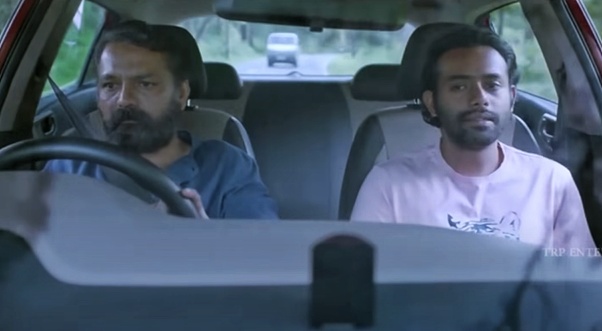
Falimy and Pranaya Vilasam indicate that the family element in this new moment of cinema is not about generational honour or inheritance, but more about an aspiration to be new subjects and the desire to participate in a new world. These narratives resonate with Madhava Prasad’s characterization of Indian new cinemas as aspirational. In Prasad’s discussion, the new cinemas are primarily staging a shift in subjectivity shaped by deep structural changes and reconfigurations in social life, brought about by the rapid and unprecedented expansion of capitalism in the subcontinent (12). Viewed in this light, one can say that these film narratives feature the family both as an expression of newly emerging individual aspirations and as a form of collective affect within a social context like Kerala, where the social composition of the middle-class population has been expanding over the last couple of decades.
This becomes evident when we consider another group of films that seek to reconcile emerging ideas of individual subjectivity with the sanctity of the domestic sphere, thereby restoring the ideal of the middle-class family. Films such as Kaathal-The Core (dir. Jeo Baby, 2023), Ullozhukku (dir. Christo Tomy, 2024), and Narayaneente Moonnaanmakkal (dir. Sharan Venugopal, 2025) each centre on a contemporary subjective conflict—between heteronormative marriage and homosexual desire in Kaathal, involving women’s individuality in Ullozhukku, and the pull between inherited family ties and the desire of the new individual subjects in Narayaneente Moonnanmakkal. The ideological work of these ‘neo-domestic’ films consists in stripping these conflicts of their dynamic social character and displacing them from the social milieu to the enclosed space of the domestic, where the narrative resolutions take place. Unlike the aspirational narratives discussed earlier, where individualisation disrupts traditional social relations and contributes to new collective imaginations, the ‘neo-domestic’ films turn this individualism inward, treating it as a private asset confined within the domestic space and shielded from external disruptions.
Both sets of films attest to the collapse of generational values and melodramatic tropes long central to Malayalam family narratives. Yet, they reveal an ongoing ideological struggle over what it means to be middle class in Kerala today – a conflict with possible political implications amid recent debates over developmental aspirations in the state. More significantly, it is through cultural narratives that this tension finds its richest expression, offering allegories that map the contradictions of the present.
Works Cited:
- Ahmed, Sara. “Affective Economies”. Social Text, vol. 22, no. 2, 2004.
- Debord, Guy. Society of the Spectacle. Rebel Press, 1992
- Paul, Anu. “Breaking Stereotypes: Portrayal of Motherhood in New-Age Malayalam Cinema with Special Reference to Kumbalangi Nights and Uyare”. SodhKosh: Journal of Visual and Performing Arts, vol. 5, no. 1, 2024.
- Prasad, M. Madhava. “Cinema in a Capitalist Republic (In the Making)”. Srinivas, S.V., Radhakrishnan, R., Chatterjee, S., & Goyal, O. (Eds). Indian Cinema Today and Tomorrow: Infrastructure, Aesthetic and Audiences. IIC Quarterly, 2021.
About the author: B. Abhijith is an Assistant Professor at the Department of Dadasaheb Phalke International Film Institute, MIT-WPU, Pune. He completed his PhD in Cultural Studies from the Department of Cultural Studies at the English and Foreign Languages University, Hyderabad. His doctoral research explores the questions of space and subjectivity in contemporary Malayalam cinema through the framework of the ideology of form.


