
Anand explores how competing “Russian worlds” took shape in Kerala during the Cold War—utopian and dystopian, romanticised and resisted. Through travelogues, Soviet children’s books, and sharp literary counter-narratives, the article traces how these visions of the Soviet Union were imagined, circulated, and contested in Malayali public life.
Anand Sreekumar
“It is nearly impossible to describe the affection of the Soviet people towards Stalin … In the Soviet Union, I saw a young population which is entirely shorn of capitalism. The future of Soviet Union is safe in their hands” – A K Gopalan
“This so-called Soviet socialist ‘heaven’ of agricultural and industrial marvels is built on the edifice of slave labour of political prisoners” – P Kesavadev
In 1952-53, the noted Communist leader A.K. Gopalan visited the 19th Communist Party of the Soviet Union (CPSU) Party Congress and narrated his experiences in a travelogue. Published in July 1953, this account titled ‘Soviet Unionil Ente Anubhavangal’ (My Experiences in the Soviet Union) was narrated in extremely evocative terms, veering from awe and exuberance for the Soviet ‘utopia’ to crushing melancholy and pathos towards the death of Stalin. This account also was an exemplification of a particular Russian world – a utopia of large-scale dams, agricultural projects and industries where ‘all workers work with a smile’ and Stalin was a ‘father to each and everyone.’ However, there also emerged literary ‘counter’ responses exemplified best by the satirical piece ‘Russia’s Lover’ by the renowned author P. Kesavadev (who had fallen out with the party by the late 1940s). A nearly line-by-line takedown of Gopalan’s travelogue, ‘Russiayude Kamukan’ (Russia’s Lover), combines trenchant humour and wit as well as an exhaustive documentation of the human rights abuses and violence of the Soviet regime to dismantle the Soviet utopia constructed by Gopalan, highlighting a totalitarian dystopia.
From adulation to disgust, from admiration to anger, the Soviet Union and Russia have pervaded (and continue to shape) the life-worlds of Malayalees. Russian leaders hog Kerala’s streets, Russian names mark its people, and Russian literature (once a mainstay) is often fondly reminisced about with nostalgia even today.
How have these worlds of Russia and the Soviet Union been constructed in Kerala’s literature? How have they been entrenched and contested? How did these world-making processes interact with the Communist internationalist currents, from the October revolt to the Cold War era? Recently, I wrote an article that sought to answer these questions, weaving a chronology of Communist internationalism and how it interacted with Kerala through these Russian worlds in literature in three distinct phases from the October Revolution to the Cold War era. In this blog, I specifically focus on the third phase, i.e., how the Communist internationalism of the Cold War era led to the construction (and contestations) of a wide range of Russian and Soviet worlds in Kerala.
It is first imperative to understand briefly the trajectory of Communist internationalism in this regard. The spread of Soviet communism and world revolution was a fundamental Bolshevik principle during the Leninist era, including through literature. After Lenin’s death, this internationalism was subordinated to “the political goals of ‘socialism in one country’” under Stalin. This culminated in the most isolated period of Soviet history from the end of the Cold War to the death of Stalin. After Stalin died in 1953, his successors brought an end to this isolationism, initiating a distinct mode of cultural internationalism seeking to build cultural understanding, international co-operation, and a sense of shared value across national borders. ” (Rupprecht, 2015) Culture constituted a major site of this internationalism, and cultural artefacts were deployed to mobilise both external and internal audiences. This has to be understood against the bipolar context of the Cold War, where both the US and the Soviet Union fought for hegemony, seeking to present their societies as models for the rapidly decolonising Third World.
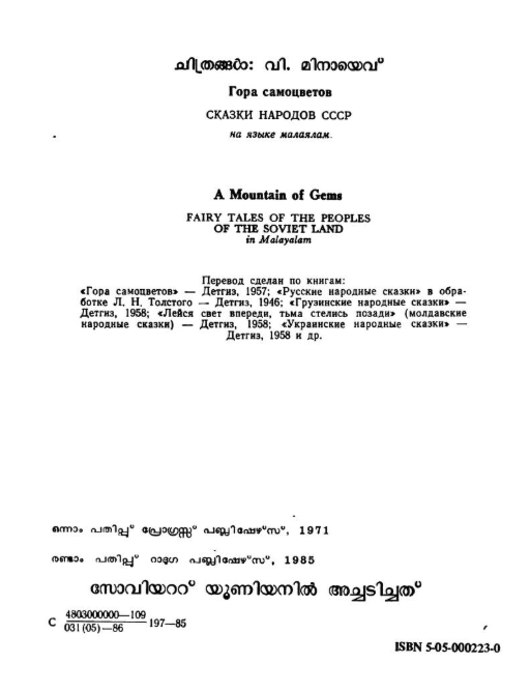
Translations of Soviet literature were critical artefacts in this regard. According to Benoy, the election of the Communist Party to power in Kerala in 1957 increased the importance of Kerala vis-à-vis Soviet cultural policies. From 1966 onwards, the Soviet government started to translate Russian works into Malayalam. To do so, a separate division was set up by Progress Publishers, a Moscow-based Soviet publisher, which traced its origins to 1931 and brought a number of translators from Kerala, most famously the couple Gopalakrishnan and Omana. They translated 192 works, spanning a wide range of genres from Russian fiction and short stories to texts on ideology, science and mathematics. A separate division called Raduga Publications was established for children’s literature in 1982. These works were distributed in Kerala by Prabhath Book House, which was registered in 1952 (Binoy 2023, 16). These ‘Soviet kathakal’, adorned with beautiful and colourful illustrations, became highly popular and influential across Kerala, especially on account of a subsidy from the Soviet Union, which made them affordable (Amerudheen, 2017).

The propagandistic value was far from subtle; the famous short story Chuck and Geck, which was popular also in Kerala, introduced the two central characters (Chuck and Geck) thus, “They lived with their mother in a great big city far, far away—there was not a finer city in the whole wide world. Day and night, red stars sparkled atop the towers of this city. And its name, of course, was Moscow.” However, beyond overt propaganda, scholars of children’s literature have argued that stories immerse children in the story worlds, enabling them to connect with children across the world. This is aided greatly by illustrations, which enable personal and empathetic responses to these characters in the story worlds. Many children of Kerala were thus immersed in the Soviet idyllic story worlds, adorned with rich and glossy illustrations.
Throughout the Cold War period, the Soviet Union also hosted a number of delegations, whose participants documented their experiences through travelogues. These travelogues also brought the Soviet Worlds to people across the world, creating, de-creating and re-creating ‘people, places and pasts’. Kerala was no different. AK Gopalan’s travelogue, as mentioned at the outset, is a canonical example in this regard. Another travelogue written by P. Balagangadhara Menon in 1973, the President of the Indo-Soviet Cultural Council, as part of a lawyers’ delegation, entrenched the utopia, highlighting the absence of beggars and the freedom to propagate religion in the Soviet Union (Menon, 1973). Similarly, in his work Ente Russian Diary published in 1986, E K Nayanar prefaced his account of his Soviet visit, invoking the words of Tagore thus, “If not for this visit to Russia, my life would have been incomplete”.
The tone of these works often remained highly defensive and protective of Stalin and the Soviet Union. Gopalan’s text was as much a travelogue as it was a defence of Stalin: “Those critics of communists who declared Stalin a ‘supreme ruler’ need to see for themselves the extent of his entrenchment in the hearts of Soviet people.” He later continued, “If Stalin is indeed a ‘supreme’ ruler, he is merely a ruler who reigns supreme over the love and respect of the Soviet people” evidencing his claim from a Russian newspaper report that he had read which reported that “in a recent election, a voter who cast his ballot from Stalin’s constituency declared in the ballot paper, ‘Along with my vote, I am also willing to sacrifice my life for Stalin.’” The people’s willingness to sacrifice themselves for Stalin was a constant undercurrent in his descriptions. Similarly, Balagangadhara Menon declared, “… there are indeed religious believers in the Soviet Union. The propaganda that communism constitutes a threat to religion is false from my experience.”
This constant defensive entrenchment of the utopia was necessary owing to the political context of the Cold War, whereby the worldmaking projects were heavily contested by a range of global and local actors. As mentioned before, the bipolarity of the world at the time led to a constant struggle for hegemony between the US and the Soviet Union, which spilt into the cultural arena as well, including literature. Scholars have noted that the US was instrumental in the construction of a Soviet dystopia, exemplified by its construction and propagation of the novel discourse of ‘totalitarianism.’ The discourse of totalitarianism had severe ideological overtones which sought to argue that the Soviet Union was characterised by total and absolute subjection of human societies to state institutions and established a contiguous tradition linking Soviet communism to the likes of fascism and Nazism, legitimising the US strategy of containment (Pietz, 1988).
However, in Kerala, the opposition to the Soviet Union emerged well before the Cold War. The clergy in Kerala, for instance, had consistently opposed the Soviet Union from the 1920s onwards owing to the threat to their faith in the post-revolution Soviet Union. This reached its pinnacle with the ascent of the Communist Party to power and its Education Bills threatening the Christian management of private educational institutions. This resulted in the ecclesiastical community (supported by caste organisations, the Congress and a wide range of actors) engaging in a highly vitriolic campaign named the ‘Liberation Struggle’. In contrast to the utopian Russian worlds prevalent in the works of Marxist literary intellectuals in Kerala, their anti-communist rhetoric created several narratives that highlighted a godless Soviet dystopia. Alluding to police firing during the Liberation Struggle, which killed three people in Angamaly, Deepika (the Catholic Church’s mouthpiece) declared, ‘The communist poison tree will not grow in this soil that is wet with life-blood of those martyrs…Their valiant cry is echoing in the horizons, and the horizons tremble. Far, far away, the cry is being repeated by bones and skills hidden in the soil of Siberia, of Puznan, of Budapest, of Lhasa.’ The communist government in Kerala represented the “ armed spies of Peking and Moscow.”
Russia’s dystopian worlds also arrived in the Malayali literary public through the works of litterateurs. As highlighted earlier, the eminent satirist, P Kesavadev, wrote ‘Russia’s Lover’, which was a line-by-line response to Gopalan’s Soviet narrations. He proclaimed, “There are two Russias. One Russia is the Russia of exploiters and the Russia of the exploited. The likes of Gopalan have only highlighted the former Russia.’ Highlighting a range of issues from human rights abuses to bureaucratic delays in the Soviet Union, he concluded, ‘Russia cannot be an example for a people who respect humanity and desire equality and freedom.’ Against the backdrop of the Soviet regime’s repression of the likes of the Nobel Prize-winning author Boris Pasternak, numerous newspaper dailies highlighted and entrenched a Soviet dystopia marked by the absence of freedom, enabled by the prevalent Cold War narrative of Russian totalitarianism. In other words, multiple literary worlds of Russia—both utopian and dystopian—collided in Kerala during the Cold War.
Conclusion
What does this brief snapshot of the Cold War internationalism imply for the debates on the ‘region’ of Kerala? Drawing from Devika, I would argue that the point is to perhaps become more sensitive to the ‘regionality’ of Kerala (rather than the ‘region’). Regions are settled and fixed; regionality, on the other hand, emphasises the dynamic nature of regions. Regionality also reminds us that regions are contingent and constructed through horizontal entanglements with a wide range of geographies and spaces, in this instance, the Soviet Union. Of course, the Soviet world does not exhaust the expressions of Communist internationalism in Kerala; the worlds of Latin America and China also shaped (and continue to) shape the imagination of Malayalees. Regionality prompts us to think both beyond accounts which paint Kerala as an ‘exceptionalist’ insular space (e.g. the Kerala model) as well as its narratives which reduce it to an identity within vertical entities like the nation (or the colony). This task becomes even more pressing today, amidst the alarming levels of fetishisation of the nation-state. The Malayali remains as much a product of India (and the sub-nation of Kerala) as the worlds of Latin America, Russia, China, Arabia and South East Asia. In a similar vein, the likes of Menon and Kooria have also reminded us that Malayali remains as much a terracentric subject as one shaped by its surrounding seas and oceans (Ala, 2022). In other words, the Malayali’s ‘miscegenation’ is inevitable.
For the whole article, see Sreekumar, A. (2025). Communist literary internationalism and worldmaking in the twentieth century: Kerala and the Soviet Union. Journal of Historical Geography, 88, pp. 108-117.
Works cited
- A.K. Gopalan, Soviet Unionil Ente Anhubhavangal: A K Gyude diary kurippukal (Calicut: Prabhath Book House, 1953), p. 26.
- Arkady Gaidar, Chuck and Geck (Moscow: Progress, 1973), p. 20.
- Dilip Menon and Mahmood Kooria. “Rethinking ‘Keraleeyatha’: Centering Oceanic Histories.” Rethinking ‘Keraleeyatha’, season 2, episode, Issue 47, edited by S. Harikrishnan, 31 Aug. 2022, ALABlog / Ala. https://alablog.in/issues/47/rethinking-keraleeyatha-ocean-history/
- Devika, ‘Rethinking “Region”: Reflections on History-Writing in Kerala’, Contemporary Perspectives 2 (2008) 246–264 (p. 262)
- Jayathilaka, The Worldmaking Role of Sri Lankan Travel Writers, pp. 56–57.
- Kerala Liberation Struggle in Pictures (Kottayam: The Deepika Publications, 1959), p. 29.
- Judith Lysaker and Tiffany Sedberry, ‘Reading Difference: Picture Book Retellings as Contexts for Exploring Meanings of Race and Culture’, Literacy 49 (2015), 105–111 (p. 105).
- Kathy G. Short, ‘Story as World Making’, Language Arts 90 (2012) 9–17 (p. 13).
- Myron Julius Lunine, ‘The Response of the Indian Intelligentsia to the Pasternak Affair: A Study in the Politics of Art’, (unpublished PhD thesis, State University of Iowa, 1963)
- P Balagangadhara Menon, Leninte Naattil (Yaathravivaraban) (Kottayam: National Book Stall, 1973).
- P Kesavadev, Russiayude Kamukan (Kottayam: National Book Stall, 1954), p. 147.
- P M. Salim, ‘The First Popular Government in Kerala and Liberation Struggle: 1957–59: A Historical Study’, (unpublished PhD thesis, University of Calicut, 2013).
- Rasmi Binoy, ‘Kerala’s “progress”ive idiom: Moscow Translators and Translation of Children’s Literature as Socialist Intermediary in Kerala’ (unpublished MA thesis, Central European University, 2023), p. 23.
- Sajid A Latheef, ‘Idyll and Ideology: An Overview of Soviet Literature for Children in Malayalam’, Sahapedia, July 26, 2019, https://www.sahapedia.org/idyll-andideology-overview-soviet-literature-children-malayalam, last accessed April 24, 2025.
- T. A Ameerudheen,. (2017, November 29). A Facebook group is preserving old Soviet books that generations of Kerala’s children grew up on. Scroll.in. Retrieved from https://scroll.in/magazine/858876/a-facebook-group-is-preserving-old-soviet-books-that-generations-of-keralas-children-grew-up-on
- Tobias Rupprecht, Soviet Internationalism after Stalin: Interaction and Exchange between the USSR and Latin America during the Cold War, 1st edn (Cambridge University Press, 2015)
- E K Nayanar, Ente Russian Diary (Thiruvananthapuram: Chinta Publishers, 1986), p. 9.
- William Pietz, (1988). The” post-colonialism” of Cold War discourse. Social Text, (19/20), 55-75.
Author bio: Anand Sreekumar is a PhD candidate at the Department of Politics and International Relations, University of Adelaide. His works have appeared in International Affairs, European Journal of International Security, South Asia: Journal of South Asian Studies and Journal of Historical Geography, among others. He is currently exploring a global history of the Kerala model in his dissertation.


